The 10% Rule for Restarting Training After Time Off — and Why Most People Break It Week One
Quick Answer: Increase your training volume (time, distance, or weight) by no more than 10% per week when restarting after injury or a long break. Your cardiovascular fitness returns faster than your tendons and connective tissue can adapt, and that mismatch is exactly where reinjury happens.
You feel good. Actually, you feel great — better than you expected for week one back. That feeling is the trap. Your lungs and heart bounce back within days; the tissue you actually injured takes months. The urge to “make up for lost time” is exactly what put most comeback athletes back on the couch.

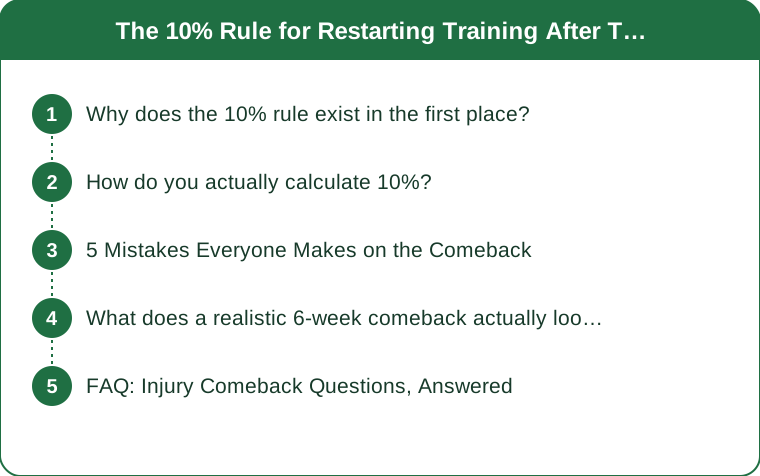
Why does the 10% rule exist in the first place?
Because your systems heal at different speeds. Cardiovascular fitness (how hard you can breathe and push) returns in days to a couple of weeks. Tendon and ligament strength — the stuff that actually failed the first time — takes months to rebuild real load tolerance.
That gap means you’ll feel ready to do your old workout long before your tissue can safely absorb it. The 10% rule is a guardrail against your own confidence, not your effort.
How do you actually calculate 10%?
Take last week’s total (minutes, miles, or total weight lifted) and add no more than a tenth.
- Walking/running: 20 minutes this week → 22 minutes max next week, not 30.
- Lifting: 100 lbs total volume on the injured-side exercise → 110 lbs max, not a jump back to your old working weight.
- Kayak/paddle/cycling: same math on total session time.
Track it in a notes app. Memory rounds up; a written log doesn’t.

5 Mistakes Everyone Makes on the Comeback
1. Judging readiness by how you feel that day. Adrenaline and excitement mask early warning signs for the first 2-3 sessions.
2. Skipping the deload week. Every 3-4 weeks of progression, cut volume by 30-40% on purpose — this is the one step almost everyone drops first.
3. Doing your old workout ‘just this once.’ One overload session can undo 3 weeks of careful progression.
4. Ignoring next-day soreness. Same-day pain is expected; soreness that’s worse the next morning means you jumped too far.
5. Comparing to your pre-injury self. That person had months of accumulated tissue tolerance you no longer have.
What does a realistic 6-week comeback actually look like?
Weeks 1-2: 50% of your last known comfortable volume, focus purely on pain-free range of motion.
Weeks 3-4: add 10% per week, introduce light resistance or pace work.
Week 5: deload — drop back 30%, let tissue catch up.
Week 6: resume 10% progression from the deloaded baseline, not from week 4’s peak.
By week 6 you’re usually at 70-80% of pre-injury volume — still 4-6 weeks from full return, and that’s normal.
FAQ: Injury Comeback Questions, Answered
How do I know if I’m progressing too fast?
Pain during the activity that’s a 3/10 or higher, or any soreness that’s worse the morning after rather than the same day. Either signal means back off 20% and hold there for a week.
Can I cross-train to speed things up?
Yes, if it doesn’t load the injured tissue the same way. Swimming while recovering from a running injury is often fine — but the 10% rule still applies to the new activity too.
When should I see a professional instead of self-managing?
If pain persists past 2 weeks of careful progression, spikes suddenly, or you feel instability (not just soreness), see a physical therapist. This is general information, not medical advice.
TL;DR:
- Add no more than 10% volume per week when restarting after injury or time off
- Cardio fitness returns in days; tendon strength takes months — that gap is where reinjury happens
- Deload 30-40% every 3-4 weeks on purpose
- Worse pain the next morning = you progressed too fast, back off 20%
The comeback that feels boringly slow in week one is usually the one that actually sticks by week six.
Keep Reading
This article is for general informational purposes only and is not medical advice. Always consult a qualified health professional for guidance specific to you.