5 Comeback Checkpoints for the Week You Stop Thinking About the Injury
Quick Answer: The riskiest phase of a comeback is not the painful part, it is the week you stop monitoring because nothing hurts. Tissue capacity lags symptom resolution by weeks. Check five things before you treat yourself as fully back: single-side strength symmetry, control at speed, tolerance the next day, unplanned movement, and whether you have actually tested the position the injury happened in.
You noticed it this week - you got through a whole session and never once thought about it.
That is genuine progress, and it is also the exact point where most people quietly skip the last third of their rehab.

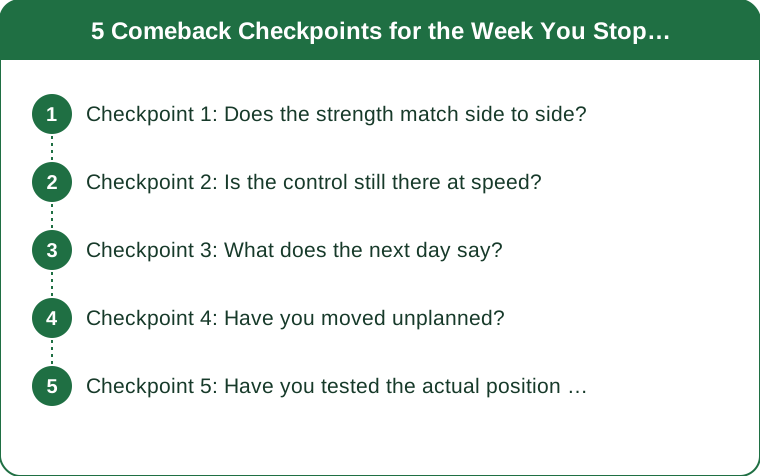
Checkpoint 1: Does the strength match side to side?
Pain-free does not mean equal. Strength deficits of 10 to 20 percent on the injured side routinely persist long after symptoms clear, and you cannot detect them in a two-legged movement because the good side compensates without asking permission.
Bilateral exercises hide this completely. A squat with a 15 percent side-to-side difference looks like a normal squat, and it will keep looking normal until something asks the weak side to work alone at speed.
How to check: test single-side. Single-leg press, split squat, single-arm press, or a single-leg calf raise to failure - whatever matches the injury. Compare reps or load between sides directly.
A gap under about 10 percent is generally considered acceptable to progress; more than that is a target rather than a verdict.
Retest every two weeks rather than once. The number is only useful as a trend, and a single test on a tired day tells you very little.
Checkpoint 2: Is the control still there at speed?
Slow, controlled movement is where rehab lives and it is not where sport happens. Tissue that handles a three-second tempo squat perfectly can still fail at the speed a stumble or a sprint start demands.
The difference is rate of force development - how fast the muscle can produce tension - and it recovers later than raw strength does. This is the single most commonly skipped stage of a comeback.
How to check: add controlled speed work and watch quality rather than output. Low box jumps with soft landings, quick step-downs, short accelerations, or fast concentric reps at moderate load.
Watch the landing specifically. Knee drifting inward, a hip that drops, a shoulder that shrugs - these show up at speed long before they show up slowly.
Progress the speed before the load, not both together. Adding both at once is the most reliable way to produce the flare-up that sets a comeback back three weeks.

Checkpoint 3: What does the next day say?
The session is not the test. The 24 hours after it are. Tissue that is not yet at capacity often feels fine during work and reports back the following morning, which is why in-session pain is such a poor guide late in a comeback.
A little stiffness that clears within an hour of moving is normal and expected. Stiffness that is worse than the day before, swelling, or a return of the original sensation is information you should act on.
How to check: rate the area out of 10 the next morning, at the same time each day, before you do anything else. Two minutes, written down.
The pattern matters more than any single number. A rating that drifts upward across a week means the load is above capacity even if no single session felt hard.
Use the 24-hour rule as your progression gate: if the next morning is unchanged, you can add a little. If it is worse twice in a week, hold where you are.
Checkpoint 4: Have you moved unplanned?
Everything in a comeback is choreographed - known load, known direction, known surface, known rep count. Real life and real sport are none of those things, and unplanned movement is what actually breaks a not-quite-ready tissue.
Reactive movement demands force in directions you did not select in advance, which is precisely the scenario most reinjuries occur in.
How to check: introduce genuine unpredictability at low intensity. A partner calling directions, a ball to react to, uneven ground on a walk, or simply a change of surface from gym floor to grass.
Start at a fraction of full effort. The point is exposure to unpredictability, not intensity - those are two separate progressions and combining them early is a classic error.
As training moves indoors over the coming weeks, surfaces change from grass to hard floor and shoes change with them. That transition is worth treating as its own small progression rather than an incidental detail.
Checkpoint 5: Have you tested the actual position it happened in?
Most people rehabilitate around the injury rather than into it. The shoulder that failed overhead gets strong at chest height; the knee that failed in a deep cut gets strong in a straight line - and confidence gets built everywhere except the place that matters.
Avoiding the specific position is completely reasonable early on. Continuing to avoid it once you are pain-free is what leaves the gap that shows up the first time sport puts you there.
How to check: reproduce the mechanism deliberately, gradually, and at low load. Overhead if it was overhead, deep range if it was deep range, single-leg landing if that is what happened.
Build it over three to four weeks rather than testing it in one session. The goal is to make the position ordinary again, not to prove something in an afternoon.
The mental side is real and worth naming. Hesitation in the specific position long after the tissue is ready is common, and it responds to graded exposure the same way the tissue does.
If any checkpoint keeps failing after several weeks of sensible progression, that is the point to get assessed rather than to push harder. This is general information, not medical advice.
TL;DR:
- The riskiest week of a comeback is the one where nothing hurts and you stop monitoring.
- Test single-side strength - bilateral movements hide 10 to 20 percent deficits completely.
- Rate of force development recovers later than strength, so add controlled speed work and progress speed before load.
- The 24-hour response is your progression gate, not how the session felt.
- Introduce unplanned movement at low intensity, and deliberately rebuild the exact position the injury happened in.
A comeback ends when all five check out, not when the pain stops. If a checkpoint keeps failing over several weeks, get it assessed.
Keep Reading
This article is for general informational purposes only and is not medical advice. Always consult a qualified health professional for guidance specific to you.