5 Questions Worth Answering Before You Book a Race in Your Comeback
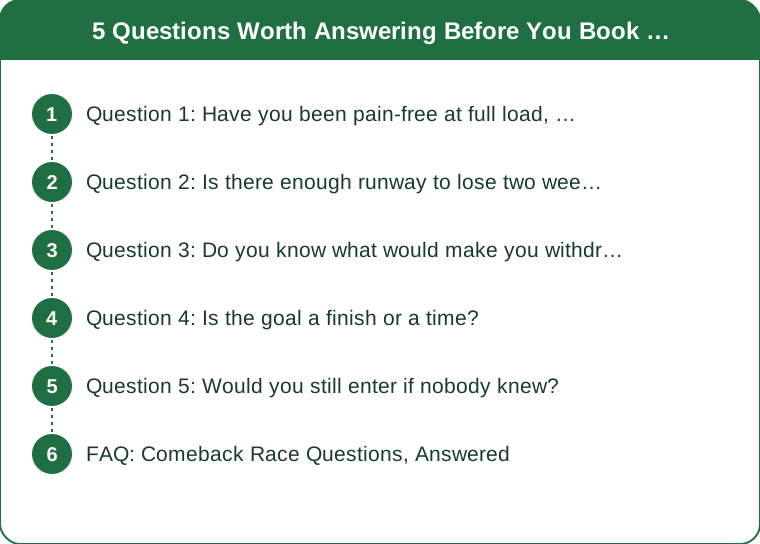
Quick Answer: Book the race only if you can answer yes to all five: you have been pain-free through full training loads for at least four weeks, the race is far enough out that you could lose two weeks and still be ready, you know what you would do if you had to withdraw, the goal is a finish rather than a time, and you would still choose this race if nobody knew you had entered.
This is general information, not medical advice.

Question 1: Have you been pain-free at full load, not just at rest?
Pain-free doing nothing is the starting line, not the finish. The meaningful test is whether you can complete the training loads a race requires without symptoms during, immediately after, or the following morning.
Four weeks is a reasonable minimum window. Tissue responses to load are frequently delayed by 24 to 48 hours, so a fortnight of feeling good is not enough data to build a race plan on.
The next-morning check is the one people skip. How a knee, tendon or back feels getting out of bed the day after a hard session tells you far more than how it felt during it.
Distinguish soreness from symptoms. General training soreness that is symmetrical and fades within a day or two is normal. Anything localised to the injured site, sharp, or worse on the second day is information.
Write it down. Three or four weeks of simple notes converts a vague sense that things are going well into something you can actually assess, and it prevents the very human tendency to remember only the good sessions when there is a race you want to enter.
And be honest about what you have modified. If you are still avoiding one movement, one surface or one intensity, you have not yet trained at full load.
Question 2: Is there enough runway to lose two weeks?
Comebacks are not linear and you should plan for the setback you cannot yet see. Choosing a race far enough out that a fortnight of disruption still leaves you ready is the difference between a manageable wobble and a lost entry.
Three months out is a reasonable floor for most endurance events, and longer if the injury was significant or the event is long.
Count backwards from the race, not forwards from today. Map the build you would need, add two weeks of contingency, and see where that lands. If it lands before today, the race is too soon.
Later in the calendar is usually better than earlier. A race in five months rather than three costs you nothing and removes almost all the pressure that makes people rush.
Consider a smaller event first. A local, low-stakes version of your race, six weeks before the one that matters, is a far better test than a taper and a start line you have invested in emotionally.
And check the refund and deferral policy before you pay. Knowing you can move the entry changes how you train, because it removes the sunk-cost pressure that pushes people through warning signs.
Question 3: Do you know what would make you withdraw?
Decide the withdrawal criteria while you are calm, not in race week. Write down what would make you not start — specific symptoms, a specific number of missed sessions, a specific failed test session.
Set a checkpoint date. A defined point six weeks out where you assess honestly, with the decision made against criteria you set in advance rather than against how much you want it.
Tell one person what those criteria are. External accountability works in both directions, and someone who knows your rules is far more useful than someone who only knows your goal.
Plan the alternative in advance. If the answer is no, what do you do instead — defer, drop to a shorter distance, volunteer, or train through to a later event? Having somewhere for the disappointment to go makes the decision far easier to actually make.
Understand that withdrawing is a training decision, not a character one. The people with long uninterrupted careers are consistently the ones who have withdrawn more often, not fewer.
And know that the pressure is almost entirely internal. Nobody else will remember whether you started, and the version of you six months from now cares far more about being able to train than about this particular Sunday.

Question 4: Is the goal a finish or a time?
A first race back should be a participation goal. Time goals require you to hold intensity when your body says stop, which is precisely the skill you should not be practising yet.
Comparing to your pre-injury performance is the fastest route back to injury. Your old times were set by a body with a different training history, and the gap says nothing about your trajectory.
Set a process goal instead. Even effort, correct fuelling, holding your technique when tired — these are all measurable, achievable, and genuinely predictive of how the next block will go.
Give yourself explicit permission to stop. A race you have decided you may walk or leave is a race you can start relaxed, and relaxed is faster than anxious.
The finish itself does real work. Completing an event ends the psychological chapter in a way that no amount of good training does, and that is a legitimate reason to race even when the time will be modest.
And plan the week after. A comeback race deserves more recovery than a normal one, and the fortnight after is where people undo it by returning to full training immediately.
Question 5: Would you still enter if nobody knew?
This is the question that catches the real reason. If a substantial part of the appeal is proving something to people who saw you injured, the race is carrying weight it cannot hold.
Social pressure distorts the decisions that matter. Entries announced publicly get started when they should not, because withdrawing feels like a public event rather than a private choice.
Notice if you are racing to end the identity gap. Feeling like you are no longer a runner, or a lifter, or an athlete is a real and painful part of a long injury, and a race is a tempting shortcut back. It works better as a milestone in a plan than as a cure for the feeling.
Consider keeping it quiet until you have started. Entering without announcing removes almost all the pressure and changes nothing about the training.
Ask what you would tell a friend in exactly your position with exactly your history. People are consistently more sensible on behalf of others.
And if the honest answer is that you want it for yourself, book it. A race chosen freely, with contingency, with a process goal and with clear withdrawal criteria, is one of the best things you can do for a comeback. The point of these questions is not to talk you out of it — it is to make sure the race is working for you rather than the other way around.
FAQ: Comeback Race Questions, Answered
How soon after being cleared can I book something?
Booking and racing are different decisions. You can enter a race five months out on the day you are cleared, provided the entry is deferrable and the plan has contingency built in.
Should I tell the medical professional treating me?
Yes, and early. Knowing there is a target date changes what they prioritise and lets them tell you plainly whether the timeline is realistic.
Is it worse to defer or to start undertrained?
Defer. Starting undertrained after an injury risks a longer setback, and the entry usually moves for a small fee. The maths is rarely close.
TL;DR:
- Four weeks pain-free at full training load, including the next morning, before you enter.
- Choose a race far enough out that losing two weeks still leaves you ready.
- Write withdrawal criteria and a checkpoint date while you are calm.
- Make it a finish, not a time — and plan extra recovery for the week after.
- If a big part of the appeal is proving something to other people, wait.
Book the race that pulls you forward, not the one that rushes you.
Keep Reading
This article is for general informational purposes only and is not medical advice. Always consult a qualified health professional for guidance specific to you.