5 Comeback Checkpoints for Returning to Outdoor Training in the Dark
Quick Answer: Coming back from injury in autumn means adding unpredictable footing, reduced visual information, colder tissue and a compressed schedule on top of a body that is still rebuilding tolerance. The five checks that matter are: can you handle uneven ground in daylight first, is your warm-up long enough for cold tissue, is your route genuinely known, is your visibility adequate in both directions, and are you tracking load rather than trusting feel. Most autumn comeback setbacks are footing-related rather than tissue-related, which means the fixes are environmental rather than physiological.
You are cleared, you feel good, and the only slot you have is 6pm - which is now dark.
Five things to check before that first session, because a comeback that survives autumn is a different plan from one that survives June.

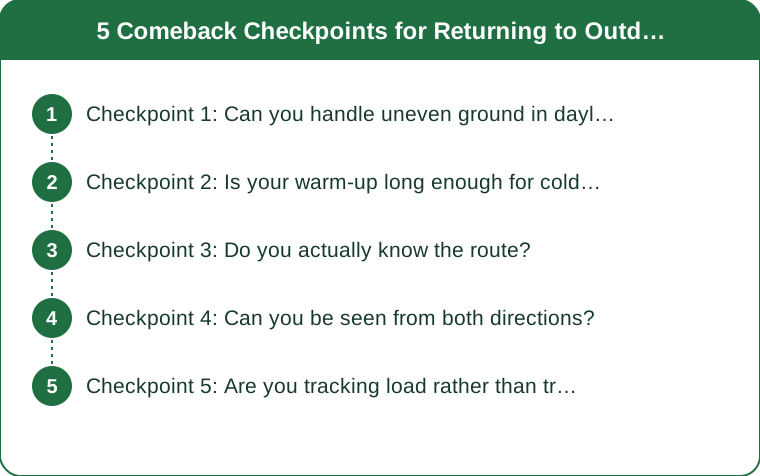
Checkpoint 1: Can you handle uneven ground in daylight first?
Do the terrain progression before the light progression. Doing both at once is how comebacks end.
Reduced light does not just make it harder to see obstacles - it degrades the visual input your body uses for anticipatory postural adjustment. In good light, you unconsciously pre-adjust foot placement and ankle stiffness for the surface ahead. In the dark, those adjustments happen reactively, after contact, which loads tissue differently and considerably more suddenly.
For a healing structure - an ankle, a knee, an Achilles, a hamstring - reactive loading is the risky kind.
The sequence that works: flat and predictable in daylight, then uneven in daylight, then flat in the dark, then uneven in the dark. Each stage should be comfortable before the next.
Autumn adds a specific hazard: wet leaves over hard surfaces are genuinely slippery, and they hide kerbs, roots and holes. A leaf-covered path is functionally uneven ground even when the surface underneath is smooth.
If you are early in a comeback, a treadmill or a well-lit track is not a compromise - it is the correct choice for the stage. Removing the footing variable entirely lets you progress load cleanly, which is the actual goal.
The practical test: if you find yourself shortening your stride and tensing through the ankle on a dark section, your body is telling you it does not have enough information. That is a reasonable signal to change route rather than push through.
Checkpoint 2: Is your warm-up long enough for cold tissue?
Cold changes tissue properties, and a comeback body has less margin than a healthy one.
Muscle and tendon are more compliant and more tolerant when warm. In cool conditions, tissue viscosity increases, and the same movement produces different loading at the same speed.
For a tissue that is still remodeling - scar tissue, healing tendon, a recently repaired muscle - that difference matters more than it does for uninjured tissue.
The autumn warm-up should be longer and more gradual than the summer one. Where five minutes was enough in August, ten to fifteen is a reasonable target in October, and more if you have gone straight from a warm indoor space into cold air.
Walk before you jog, jog before you run. For a comeback specifically, the first ten minutes should feel almost pointlessly easy.
Layer for the warm-up and remove after, rather than starting cold and warming up into it. The tissue you are protecting is often peripheral - Achilles, calf, hamstring - and those cool fastest.
And do the warm-up before you leave the house where you can. Standing outside in the cold doing mobility work is worse than doing it indoors and walking out already warm - particularly on the dark evenings when standing still in the cold is genuinely unpleasant and therefore gets skipped.

Checkpoint 3: Do you actually know the route?
Route familiarity substitutes for visual information, and a comeback is not the time to explore.
On a route you know well, you have a mental map of the surface - where the broken pavement is, where the kerb drops, where it floods. That map does a substantial portion of the work your eyes would otherwise do.
On an unfamiliar route in the dark, you have neither.
Run new routes in daylight first, at least once, specifically looking at the surface rather than the scenery. It sounds excessive and it takes one session.
Prefer looped short routes over long point-to-point ones during a comeback. A one kilometer loop repeated four times means you learn the surface immediately, you are never far from home if something feels wrong, and you can stop at any lap without a long walk back - which is the single most useful property in a comeback session.
Check the lighting quality, not just its presence. A street light every fifty meters creates alternating bright and dark patches, and the eye’s adaptation between them is slow - the dark patches are effectively darker than a uniformly unlit path.
And have a bail-out. Knowing where you would stop, and how you would get home, removes the pressure to continue a session that has stopped feeling right. Comebacks fail more often from continuing than from starting.
Checkpoint 4: Can you be seen from both directions?
Most reflective setups are front-facing, and most risk comes from behind.
This is a safety checkpoint rather than a tissue one, but it belongs in a comeback plan because a collision or a fall ends a comeback faster than any training error.
Reflective material works only when illuminated, which means it works for drivers with headlights on and not for anyone else. Active lights - a small blinking rear light and a white front light - are visible independently and are considerably more effective.
Check the back. Most running jackets have reflective detail on the front and shoulders. A driver approaching from behind sees your back, and that is where the visibility usually is not.
Moving reflectives on ankles and wrists are disproportionately effective because motion attracts attention far more than a static patch.
Run facing traffic on roads without pavement, and be aware that this changes on which side you should carry your lights.
And keep one ear available. Headphones at a volume that masks traffic remove a whole sensory channel at exactly the time your visual channel is already reduced. Bone conduction or one earbud out is the standard compromise.
Tell someone the route and expected time, or use a live-tracking feature. During a comeback, when there is a genuine chance of stopping mid-session, this matters more than usual.
Checkpoint 5: Are you tracking load rather than trusting feel?
Autumn sessions feel easier and are frequently harder, which corrupts the feedback a comeback depends on.
Cooler air lowers perceived exertion at the same pace. The consequence during a comeback is running faster than planned while feeling like you did not - which means load increases without a decision being made.
Write the session down before you go and follow it. Duration, or distance, or a run-walk structure. A comeback should be executing a plan, not responding to how the run is going.
The commonly used ten percent rule - increasing weekly volume by no more than roughly ten percent - is a rough heuristic rather than a law, but it exists to prevent exactly the autumn pattern of feeling good and adding thirty percent in a week.
Track the delayed response, not the session. For a comeback, the useful data point is how the area feels 24 and 48 hours later, and whether it settles within a day. A session that felt fine and produces two days of soreness in the healing structure was too much regardless of how it felt at the time.
Keep a simple log: duration, surface, light conditions, how it felt, and how the area was the next morning. Six weeks of that log will tell you more about your tolerance than any generic protocol.
This is general information, not medical advice. Pain that increases during a session, night pain, swelling, or any loss of function should go to the clinician managing your rehabilitation rather than into a training log.
TL;DR:
- Progress terrain before light. Flat in daylight, uneven in daylight, flat in the dark, then uneven in the dark.
- Wet leaves make a smooth path functionally uneven and hide kerbs and roots.
- Warm up ten to fifteen minutes in cool weather, indoors where possible - healing tissue has less margin when cold.
- Know the route in daylight first, and prefer short repeated loops with an easy bail-out.
- Most visibility gear faces forward; most risk comes from behind. Use active lights and moving reflectives.
- Cool air lowers perceived effort - write the session down beforehand and follow it.
- Judge by how the area feels at 24 and 48 hours, not by how the session felt.
This is general information, not medical advice. Autumn comeback setbacks are usually footing, not tissue - which means they are preventable.
Keep Reading
This article is for general informational purposes only and is not medical advice. Always consult a qualified health professional for guidance specific to you.