5 Signs You're Actually Ready to Return to Full Training After Injury
Quick Answer: Full-speed movement without hesitation, matched strength between both sides, and no lingering swelling after activity are among the clearest signs you’re ready for full training — a doctor’s clearance is the starting point, not the finish line.
Getting cleared feels like the finish line. But plenty of people get cleared and still aren’t actually ready to train the way they used to — here’s how to tell the difference.

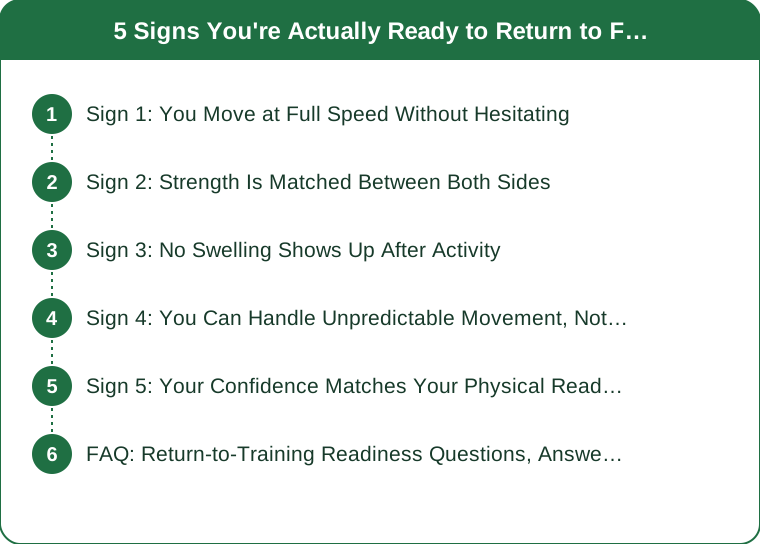
Sign 1: You Move at Full Speed Without Hesitating
If you catch yourself slowing down or subtly favoring the injured side during quick movements, your nervous system is still protecting it, even if the tissue itself has healed.
Genuine readiness looks like moving at game or workout speed without a conscious mental check on the injured area first.
Sign 2: Strength Is Matched Between Both Sides
A strength test comparing the injured side to the uninjured side — within about 10% — is a more reliable readiness marker than pain alone, since pain can resolve well before strength fully returns.
Many people return to training with a 20-30% strength gap they don’t notice until they’re pushed under real load, which is when reinjury risk climbs.
Sign 3: No Swelling Shows Up After Activity
Swelling that appears hours after a workout, even without pain during it, signals the tissue is still reacting to load it isn’t fully ready for yet.
A genuinely ready joint or muscle stays calm the next morning, not just calm immediately after the session ends.

Sign 4: You Can Handle Unpredictable Movement, Not Just Controlled Drills
Controlled gym exercises are the easiest test — the real marker is handling a sudden direction change, an off-balance moment, or unplanned contact without the injured area reacting.
Many comebacks stall here because rehab environments are predictable, and real training and sport are not.
Sign 5: Your Confidence Matches Your Physical Readiness
Persistent hesitation or fear around the injured area, even after physical markers look fine, is itself a readiness signal worth addressing — mental readiness and physical readiness don’t always arrive on the same timeline.
Working with a coach or PT on graded exposure to the feared movement closes this gap faster than just waiting for confidence to return on its own.
FAQ: Return-to-Training Readiness Questions, Answered
Is a doctor’s clearance enough to return to full training?
It’s the necessary first step confirming the tissue has healed, but strength, movement quality, and confidence checks matter just as much before going back to full intensity.
How long does the strength gap between sides usually take to close?
It varies a lot by injury type and person, but several weeks of targeted single-side strength work after clearance is common before reaching a matched baseline.
What if I still feel some hesitation months after clearance?
That’s worth addressing directly with a coach or physical therapist rather than pushing through — lingering hesitation months out often points to an unaddressed strength or confidence gap.
TL;DR:
- A doctor’s clearance is the starting point for return to training, not proof you’re fully ready
- Matched strength between both sides matters more than the absence of pain
- Swelling the next morning after activity means the tissue isn’t fully ready yet
- Confidence and mental readiness deserve as much attention as physical markers
If even one of these five doesn’t check out yet, that’s useful information — not a setback. This is general information, not medical advice.
Keep Reading
This article is for general informational purposes only and is not medical advice. Always consult a qualified health professional for guidance specific to you.