How to Trust an Injured Body Part Again (When It Is Healed but You Are Not)
Quick Answer: Fear of re-injury - clinicians call the strong version kinesiophobia - is a normal, separate recovery track that routinely lags tissue healing by weeks or months, and it is now recognized as one of the biggest predictors of who actually returns to full activity. The brain that watched you get hurt turned up protection around that body part: guarding, bracing, hesitation, attention glued to the spot. The way through is graded exposure - a ladder of specific feared movements climbed in small, repeated, boring steps - plus load evidence (strength numbers) the brain finds more convincing than reassurance. Confidence is trained, not waited for.
The physio discharged you. The scan is clean. And at the bottom of the squat - the exact angle where it happened - something in you taps the brakes every single time. That is not weakness of nerve, and it is not imaginary. It is the second injury, the one nobody scheduled rehab for.

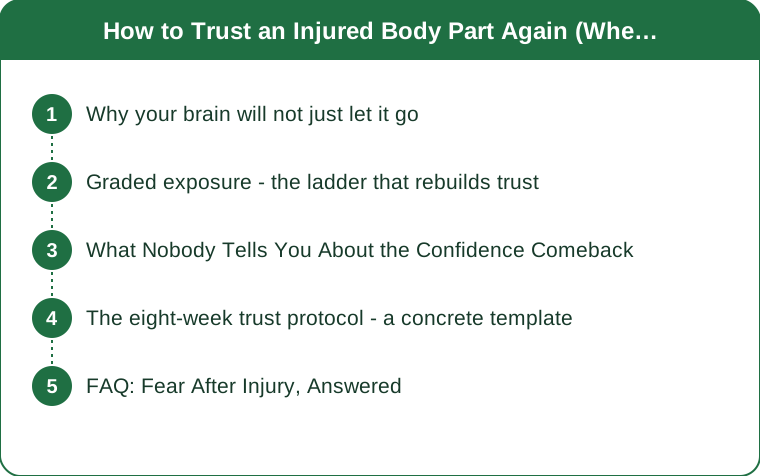
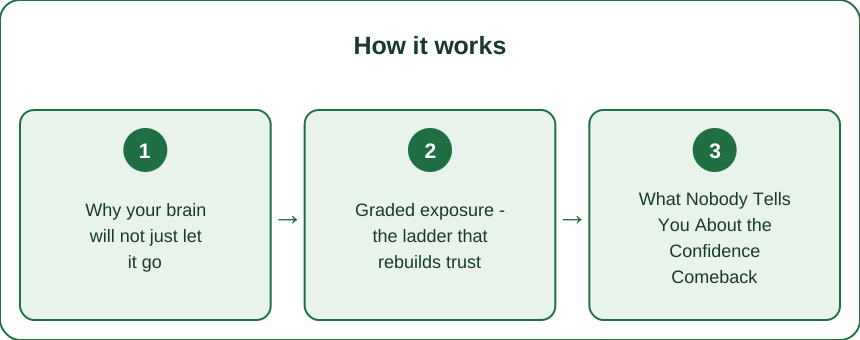
Why your brain will not just let it go
The hesitation is a feature that has outlived its job.
Injury recalibrates the protection system. Pain science’s central finding of the last two decades: pain and protective behavior are outputs the brain produces based on perceived threat, not pure readouts of tissue state. After an injury - especially a vivid or story-rich one (the pop, the fall, the months off) - the system reasonably turns sensitivity up around that area. Guarding, stiffness on approach to certain angles, and attention constantly monitoring the spot are the protection system doing its job past the point of usefulness.
The fear is movement-specific, which proves it is learned. You are not afraid of the knee; you are afraid of the knee at depth, or the ankle on uneven ground, or the back under a hinge. The precision is the tell: this is associative learning - the alarm wired to the circumstances of the original event - and associative learning is exactly what graded exposure was invented to rewrite.
Avoidance feels protective and quietly feeds the loop. Skip the feared angle and the relief teaches the brain the danger was real; the movement stays untested, the guarding pattern strengthens, and detraining makes the area genuinely less capable - manufacturing the very fragility the fear predicted. This avoidance spiral, well documented in rehab research, is why fear at discharge predicts re-injury and non-return better than most physical measures.
And guarding changes mechanics in ways that matter. Moving stiffly, off-loading one leg, holding breath at the feared angle - protective patterns are often less safe than confident movement: they redistribute load to tissues that never trained for it. The goal is not courage for its own sake; it is that trust produces better mechanics than fear does.
Graded exposure - the ladder that rebuilds trust
The method is unglamorous and extremely well supported: list what you fear, order it, climb it slowly, repeat each rung until boring.
Build the specific ladder. Write the actual feared movements, not categories - kneeling on that knee, bodyweight squat to full depth, step-down from a curb, jog on grass, cut left. Rank them 0-10 by dread. Your ladder is yours: two people with identical ACL histories produce completely different lists, and the list is the treatment map.
Start at a 3-4, not a zero. Rungs that provoke mild, manageable apprehension are where relearning happens; rungs at zero teach nothing, rungs at 8 rehearse panic. The step should feel like slight bravery, not like a dare.
Repeat until boring, then step up. Boredom is the graduation criterion - do the step-down ten times a day for four days and somewhere in there the brain stops flagging it. Small daily doses beat weekly heroics, because the alarm updates on repetition density.
Attach load evidence alongside. The brain trusts numbers it produced: single-leg calf raises to fatigue matched left-right, goblet squat progressions, hop-and-stick counts. Objective strength work does double duty - it rebuilds real capacity and hands the protection system hard evidence that the area handles load. Confidence follows measured capability far more reliably than it follows reassurance.
Recruit context deliberately. Feared movements first in controlled settings - shoes on, flat floor, fresh, unhurried - then progressively wilder: tired, outdoors, faster, reactive. The last rungs should resemble the original injury context closely, because that context is where the alarm lives.
Expect sensations and have a plan for them. Twinges, tightness, and next-day awareness are part of tissue re-loading, not proof of damage. Agree with yourself (or your physio) in advance what response means continue, what means repeat this rung longer, and what genuinely means get assessed - a pre-made decision rule keeps one weird Tuesday from collapsing the ladder.

What Nobody Tells You About the Confidence Comeback
There is usually one keystone movement, and it unlocks the rest. For knee people it is often kneeling or the deep squat; for ankles, uneven ground; for backs, picking something off the floor fast. Clearing the keystone - the movement most fused with the injury story - tends to cascade confidence through the whole list, so it deserves the most patient, most deliberate laddering rather than permanent quarantine.
The flinch outlives the fear. Long after you stop consciously worrying, a residual brace or micro-hesitation can persist at the old angle - like a scar in the movement. It fades with volume, and it fades faster when movement gets externally focused: catch a ball during the step-down, hold a conversation during the squat set, count music beats. Attention aimed outward is the oldest trick in rehab for dissolving guarding, because the brace needs your attention to run.
Ritual and gear legitimately help, with an expiry date. The warm-up sequence, the taped ankle, the compression sleeve, the specific leggings you wore when things went well - all can function as confidence scaffolding, and scaffolding is fine. The maturity move is scheduled weaning: sleeve on for the session’s hardest set only, then off entirely a month later. Scaffolding that never comes down becomes the new dependence.
Watching yourself move updates the story. Filming a clean set of the feared movement and watching it back is startlingly effective - the outside view shows smooth, symmetrical, unremarkable movement while the inside view still reports danger. The discrepancy itself is therapeutic evidence. (It also catches genuine residual asymmetries worth training, which is the honest second use.)
Beware the overshoot day. Somewhere mid-comeback arrives a great day - and the temptation to skip four rungs and test everything. The classic re-injury is not the feared movement done gradually; it is the celebration workout done rashly. Progress banked slowly survives enthusiasm; progress grabbed in one day often does not.
And fear that spreads instead of shrinking deserves professional company. If dread is generalizing to more movements, sleep is involved, or the injury replays intrusively, that is beyond a self-run ladder - physios with pain-science training and sports psychologists treat exactly this, routinely and well.
The eight-week trust protocol - a concrete template
Adapt freely; the structure is the point. Assumes medical clearance for full activity.
Weeks 1-2: audit and floor. Write the fear ladder, film your baseline attempt at the keystone movement, and establish load evidence baselines (single-leg strength matched side-to-side where relevant). Begin daily doses of two low-rung movements, one minute each, plus your normal training around them. The week-one win is precision: knowing exactly what you avoid.
Weeks 3-4: dose the middle. Two or three middle-rung movements daily, repeated to boredom; keystone movement introduced in its most controlled form (partial range, support nearby, fresh). Add external focus - ball tosses, conversation, music - to one exposure per day. Strength work progresses on numbers, not vibes.
Weeks 5-6: context and speed. Take cleared movements wilder: outdoors, mild fatigue, gentle speed. Keystone progresses toward full range and full weight. Start deliberate scaffolding-weaning: supportive gear only for the hardest set. Re-film the keystone and watch it next to week one - the difference is usually the most motivating artifact of the entire comeback.
Weeks 7-8: rehearse the original context. Build toward the movement-in-circumstances that most resembles the injury - the cut on grass, the fast floor pick-up, the crowded class - in planned, repeated doses. Finish with a self-test day: keystone movement, loaded, tired, filmed, boring. Boring is the finish line.
Throughout, two metrics on the fridge: the dread score of the keystone (should trend down across weeks, not days) and one strength number (should trend up). When both cross - dread under 3, strength matched within roughly 10 percent of the other side - you have objective permission to call the second recovery done.
One honest boundary: pain that is sharp, swelling that recurs, or symptoms that worsen week over week are tissue questions, not courage questions - loop your clinician back in before climbing further. The ladder is for cleared bodies with uncleared alarms.
This is general information, not medical advice - severe or worsening symptoms, and fear that significantly disrupts life, deserve individual professional care.
FAQ: Fear After Injury, Answered
Is it normal to still be scared months after my injury healed?
Completely - psychological readiness routinely lags tissue clearance by weeks to months, and fear of re-injury is one of the most common reasons people never fully return. The lag is a learned protection response, not a character flaw, and it responds to structured exposure faster than to time alone.
How do I stop favoring my previously injured side?
Combine graded exposure to the specific movements you protect with objective strength matching - single-leg work until the sides test close to even - and use external focus (targets, balls, conversation) to interrupt the guarding, since bracing needs attention to run. Filming yourself accelerates it by showing the smooth movement your insides refuse to report.
What if I feel a twinge during exposure work - stop or continue?
Decide the rule in advance: mild, brief sensations that settle by the next day generally mean continue at the same rung; symptoms that sharpen, swell, or build across sessions mean pause and reassess with a professional. A pre-agreed decision rule prevents one ambiguous Tuesday from collapsing weeks of progress.
Does bracing or taping help or hurt confidence?
Both, sequentially: as scaffolding early, supports genuinely help people attempt the movements that rebuild trust; kept forever, they become the thing confidence depends on. Use them deliberately and wean them on a schedule - hardest set only, then off - so the trust ends up in the body, not the neoprene.
When does fear after injury need professional help?
When it spreads to more movements instead of fewer, disrupts sleep, replays intrusively, or has you quietly reorganizing life around avoidance months later. Physios trained in pain science and sports psychologists treat kinesiophobia as core business - it is a referral, not a confession.
TL;DR:
- Cleared tissue plus persistent hesitation is the normal pattern: the brain’s protection system recalibrates after injury and lags the healing by months.
- Avoidance feeds the loop - relief teaches the brain the danger was real while detraining manufactures actual fragility.
- The fix is graded exposure: a specific fear ladder climbed at mild-apprehension level, repeated until boring, plus strength numbers the brain finds convincing.
- Use external focus to dissolve guarding, film the keystone movement for evidence, wean scaffolding on a schedule, and beware the celebratory overshoot day.
- Dread trending down and side-to-side strength matching up are the objective finish line; spreading fear or worsening symptoms bring professionals back in.
The first recovery happened in your tissue on biology’s schedule. The second happens in your nervous system on repetition’s schedule - and repetition is entirely yours to supply.
Keep Reading
This article is for general informational purposes only and is not medical advice. Always consult a qualified health professional for guidance specific to you.