5 Checkpoints That Tell You It Is Safe to Add Load After an Injury
Quick Answer: Before adding load, you want five things: full pain-free range of motion, symmetry within about 10% side to side, the ability to do the movement slowly under control, no next-day flare, and confidence that isn’t faked. Miss any one and you’re gambling. Most re-injuries happen in the two weeks after someone feels fine — feeling fine arrives well before tissue capacity does.
The hardest part of a comeback isn’t the painful phase. It’s the phase right after, when nothing hurts and every instinct says go.
Here are five checkpoints you can actually test, one at a time.

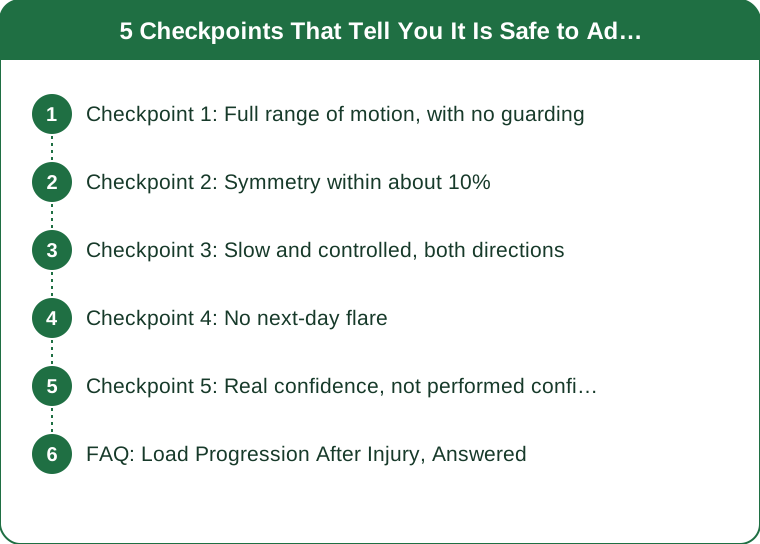
Checkpoint 1: Full range of motion, with no guarding
Before load, you want range — and range that doesn’t come with a flinch.
Compare the injured side to the uninjured side through the full arc of the joint. A knee that bends to 130 degrees when the other bends to 145 is not ready for squats under weight, no matter how good it feels standing still.
Watch for guarding rather than pain. Guarding is the subtle hesitation at end range — you’ll feel yourself slow down slightly before you get there. That’s the nervous system protecting something, and it’s information.
Test it cold, not warm. Range that only shows up after twenty minutes of warmup is range you don’t own yet. Check it first thing in the morning, before anything else.
If range is short, that’s your work for the week. Load can wait.
Checkpoint 2: Symmetry within about 10%
Numbers beat feelings, and this is where you get numbers.
Pick a test you can measure on each side separately. Single-leg sit-to-stand reps from a chair, single-leg calf raises to failure, a single-arm carry for time — the specific test matters less than testing each side alone.
Under about a 10% gap, you’re in reasonable territory. A 20 to 30% gap means the injured side is still doing substantially less work, and bilateral movements will quietly let the strong side cover for it.
This is the checkpoint people skip most, because bilateral exercises hide asymmetry beautifully. A back squat feels symmetric while one leg does 60% of the work.
Retest weekly, same conditions, same time of day. The trend matters more than any single number.
Checkpoint 3: Slow and controlled, both directions
If you can’t do it slowly, you can’t do it — you’re using momentum to skip the part that hurts.
Take the movement you want to load and do it at a three-second lowering, one-second pause, three-second raise. Bodyweight only. If the pause is where it falls apart, that’s your answer.
The pause is diagnostic. Momentum carries you through the range where tissue capacity is lowest. Removing it exposes exactly the position that still needs work.
Control on the way down matters more than the way up. Eccentric loading is where tendon and muscle adapt, and it’s also where uncontrolled comebacks go wrong. If the lowering phase collapses, drop the range until it doesn’t.
Only when three seconds down, one second held, three seconds up is genuinely easy does external load make sense.

Checkpoint 4: No next-day flare
The session that felt fine and the morning after are two different pieces of evidence, and the morning wins.
Some soreness is expected and fine. Diffuse muscle soreness that eases with movement is normal adaptation. Sharp, localized, or joint-line pain that’s worse than before the session is not.
Use a 24-hour rule. Whatever you did, check in the next morning. Same or better means the dose was right. Clearly worse means you went past capacity — drop back to the last dose that didn’t flare and hold there for a week.
The flare often shows up on day two, not day one. Tendon issues in particular are notorious for a delayed response. If you’re rebuilding a tendon, wait a full 48 hours before calling a session successful.
Keep a two-line log. What you did, how the next morning felt. Three weeks of that tells you more than any protocol you find online.
Checkpoint 5: Real confidence, not performed confidence
Your brain has been protecting this thing for weeks, and it doesn’t update automatically.
Test it honestly: can you load it without bracing for something? If you’re mentally flinching before the rep, the movement pattern is going to be off — and altered patterns are how you injure the other side.
Confidence rebuilds through graded exposure, not through pep talks. Do the movement at a load so easy it’s boring. Then slightly less boring. The goal is a long series of uneventful sessions, which is exactly what convinces a nervous system that something is safe again.
Watch for the opposite failure too. Some people come back overconfident and load aggressively to prove the injury is over. That impatience is behind a large share of second injuries.
If pain has lasted longer than expected, or you’re not progressing across several weeks of sensible work, see a physical therapist or physician. A single assessment often saves months. This is general information, not medical advice.
FAQ: Load Progression After Injury, Answered
How much weight should I add once all five checkpoints pass?
Start at roughly 50% of what you were using before the injury, and add about 10% per week as long as no checkpoint regresses. It feels absurdly light. That’s the point — the first four weeks are about accumulating uneventful sessions, not testing capacity.
What if one checkpoint passes and another doesn’t?
Work the failing one. If range is fine but symmetry is 25% off, do unilateral work until the gap closes. Checkpoints aren’t a scoring system where four out of five is a pass.
Is some pain during rehab acceptable?
Many rehab protocols allow pain up to about 3 out of 10 during the exercise, provided it settles within 24 hours and doesn’t worsen week to week. Sharp, increasing, or lingering pain is a different signal. If you’re unsure which you have, that’s a conversation for a professional.
How long does a comeback usually take?
It depends entirely on tissue and severity — muscle strains often resolve in weeks, tendon issues frequently take three months or more. The common thread is that almost everyone underestimates it, and almost nobody regrets going slower.
TL;DR: Feeling fine arrives before being ready. Test, don’t guess.
- Full pain-free range, checked cold — not range that only appears after a long warmup.
- Symmetry within about 10% on a single-sided test. Bilateral movements hide gaps.
- Three seconds down, one-second pause, three up with bodyweight before any external load.
- No next-day flare. Check the morning after, and wait 48 hours for tendons.
- Genuine confidence, built through a long run of boring, uneventful sessions.
The two weeks after you stop hurting are the highest-risk window of the entire comeback. Spend them being unimpressive.
Keep Reading
This article is for general informational purposes only and is not medical advice. Always consult a qualified health professional for guidance specific to you.