5 Things Worth Tracking During Your Injury Comeback
Quick Answer: Pain level alone is a poor comeback progress marker, since it fluctuates day to day for reasons unrelated to healing. Tracking range of motion, next-day soreness, sleep quality, and confidence in the movement gives a fuller, more reliable picture of whether a comeback is actually on track.
Most people track pain and nothing else during a comeback — but pain alone misses most of the actual signal.

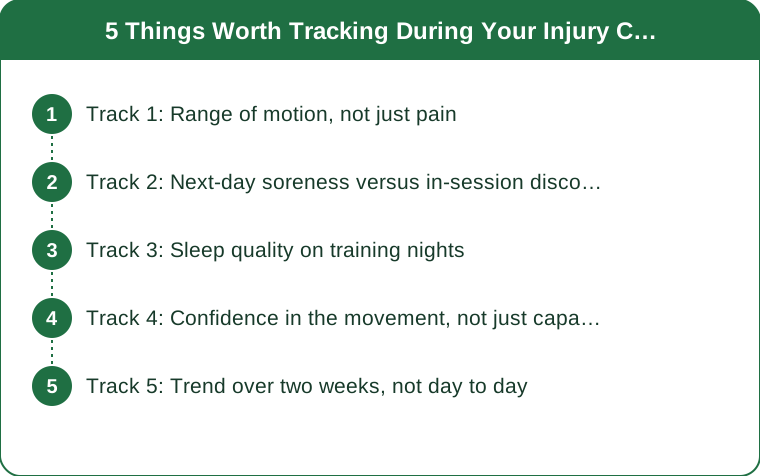
Track 1: Range of motion, not just pain
Noting whether a joint or movement’s usable range is improving, staying flat, or regressing session to session catches trends that a single pain rating misses, since range often changes before pain does in either direction.
Track 2: Next-day soreness versus in-session discomfort
Discomfort during a session that fully resolves by the next day reads very differently than soreness that lingers or worsens 24-48 hours later — the delayed marker is usually the more meaningful one for judging whether a session’s load was appropriate.

Track 3: Sleep quality on training nights
Disrupted sleep on nights following a comeback session can be an early sign the body is under more stress than the session felt like in the moment, making sleep quality a useful indirect marker worth logging alongside training itself.
Track 4: Confidence in the movement, not just capability
Being physically able to perform a movement and feeling confident doing it are different things during a comeback — logging a simple confidence rating alongside performance catches the psychological piece of recovery that pure physical metrics miss entirely.
Track 5: Trend over two weeks, not day to day
Comeback progress is rarely linear, so comparing a single day against the day before often looks discouraging even during genuine overall progress — reviewing the trend across a full two-week window gives a much more accurate read on whether things are actually moving forward.
TL;DR:
- Pain alone misses most of the real signal during a comeback
- Range of motion and next-day soreness reveal trends pain ratings don’t
- Sleep quality and movement confidence are worth tracking alongside physical metrics
- Reviewing progress over two weeks, not day to day, gives an accurate picture
A slightly fuller tracking approach turns a confusing, up-and-down comeback into a clearer, trackable process.
Keep Reading
This article is for general informational purposes only and is not medical advice. Always consult a qualified health professional for guidance specific to you.