5 Ways Your Sleep Changes During an Injury Comeback - and Why It Matters
Quick Answer: Injury disrupts sleep through pain that surfaces at night, forced changes in sleeping position, reduced daytime activity that weakens sleep drive, altered training timing, and the anxiety that accompanies an uncertain comeback. Because a large share of tissue repair processes are sleep-dependent, disrupted sleep directly slows recovery - which makes sleep one of the few genuinely high-leverage things you can address while injured.
You are doing the rehab, taking the rest days, and following the plan. And you have been sleeping badly for six weeks without treating that as part of the injury.

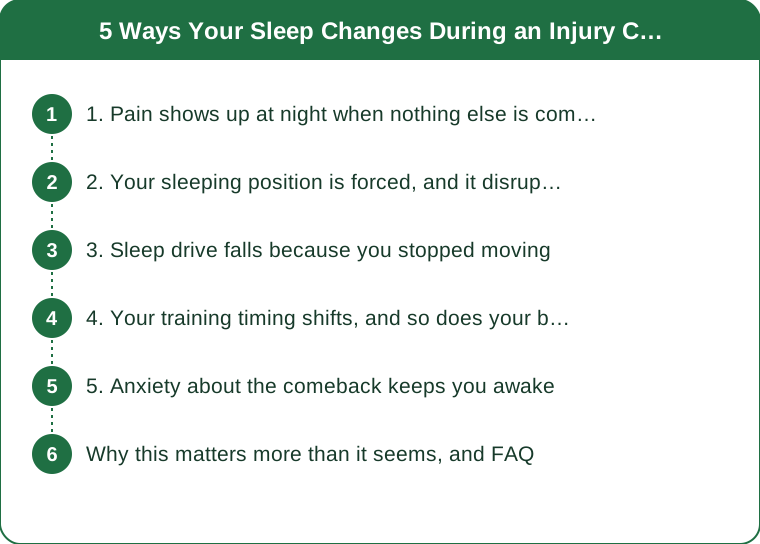
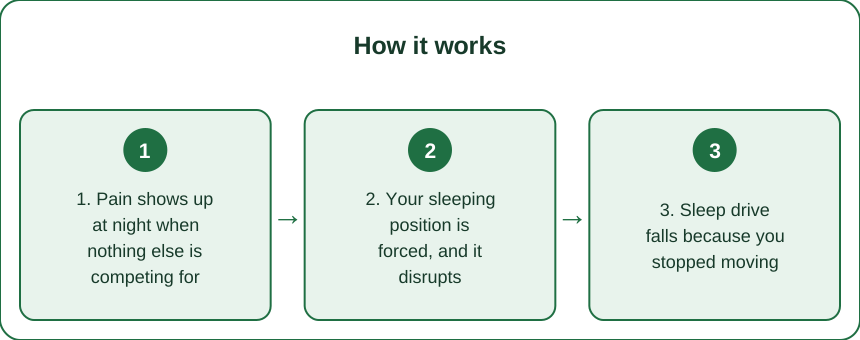
1. Pain shows up at night when nothing else is competing for attention
This is the most common change and the most under-reported.
Distraction suppresses pain perception during the day. Work, movement, and conversation all compete for attention. At night, in a quiet dark room, there is nothing else to attend to, and the same level of pain feels considerably more prominent.
Some injuries are genuinely worse at night for physiological reasons. Inflammation and tissue swelling can increase with prolonged inactivity, and lying still for hours allows fluid to accumulate around an injured area.
Pain that wakes you repeatedly fragments sleep architecture, reducing time in the deeper stages where most restorative processes occur. You can spend eight hours in bed and get considerably less benefit than the number suggests.
What helps: timing any prescribed pain relief so it covers the night rather than the day, elevating a swollen limb, and using pillows to support the injured area in a position that reduces load.
Worth flagging to a clinician: pain that consistently wakes you at night, or pain that is worse at rest than during activity, is clinically meaningful information and should be mentioned rather than tolerated.
2. Your sleeping position is forced, and it disrupts everything
An underrated source of poor sleep, particularly with shoulder, hip, and back injuries.
Most people have a strong habitual sleeping position, and being unable to use it produces genuine difficulty falling asleep and more frequent waking.
Shoulder injuries are the clearest case. Side sleepers with a shoulder injury frequently cannot use either side comfortably - the injured side hurts and the other side often aggravates it too through the position of the arm.
Back and hip injuries change which positions are tolerable, and the tolerable ones are often not the ones you find restful.
Pillows do more than most people try. A pillow between the knees for hip and back issues, a pillow supporting the arm for shoulder injuries, and a pillow under the knees when sleeping on your back all change load meaningfully.
Give it time and expect adaptation. Sleeping in an unfamiliar position is disruptive for one to two weeks and then becomes considerably easier. People often abandon a helpful position after three nights, before adaptation has had a chance.
3. Sleep drive falls because you stopped moving
The mechanism people almost never connect, and one of the most fixable.
Physical activity is a major driver of sleep pressure. Reduced daytime activity means less accumulated drive to sleep, which produces difficulty falling asleep and lighter sleep even without pain.
Injury usually cuts activity dramatically, and not just the training - people move less generally when injured, taking fewer steps, avoiding stairs, and sitting more.
The result is a frustrating combination: more tired in a general sense, less physically able to fall asleep.
What helps: maintain whatever movement the injury allows, deliberately. Walking with an upper body injury, upper body work with a lower limb injury, swimming where appropriate. This is not just about fitness maintenance - it directly supports sleep.
Daylight exposure matters independently. Injured people often spend far more time indoors, which weakens circadian signalling. Getting outside in the morning, even briefly, is a genuine intervention and costs nothing.
And avoid long daytime naps if you are struggling at night. Understandable when tired and poorly slept, and they reduce night-time sleep pressure further.

4. Your training timing shifts, and so does your body clock
A subtle change with real consequences.
Training is a circadian cue. Consistent exercise at a regular time helps anchor the daily rhythm. Losing it removes one of the more reliable anchors in a typical day.
Rehab often happens at different times than training did, frequently in the evening after work, which for some people is more activating than helpful before bed.
The 6am alarm often disappears too. Without early training, wake times drift later and become less consistent, and consistent wake time is the single strongest lever for stable sleep.
What helps: keep the wake time you had while training, even if you are no longer getting up to train. It is the most effective single habit for maintaining sleep quality through a comeback.
Do rehab earlier in the day where possible, particularly anything demanding. Late-evening rehab that leaves you sore and alert is not helping the night that follows.
And keep a routine around the evening. The structure that training provided is worth replacing with something rather than leaving as a gap.
5. Anxiety about the comeback keeps you awake
The one people are least likely to mention and most likely to experience.
Uncertainty is cognitively demanding. Not knowing whether you will return to full capacity, whether the timeline is realistic, or whether a twinge means a setback produces rumination, and rumination peaks in the quiet before sleep.
Loss of identity is a real component for people whose training is a significant part of how they see themselves. That is not an overstatement and it affects sleep the way other significant stressors do.
Sleep loss and anxiety reinforce each other. Poor sleep increases emotional reactivity and worry, which further impairs sleep. Breaking into that loop at any point helps.
What helps: writing down the plan and the current status before bed, so the rumination has somewhere to go other than in circles. Concrete rehab milestones reduce the uncertainty that drives the worry.
Talk to someone about the timeline. A great deal of comeback anxiety comes from not knowing what is normal. A physiotherapist can usually tell you, and the reassurance is genuinely effective.
And if low mood or anxiety persists, it is worth raising with a healthcare professional. Psychological difficulty during long injury recovery is common, well recognised, and treatable, and it is not a failure of resilience.
This is general information, not medical advice. Persistent pain, sleep disturbance, or low mood during recovery should be discussed with a healthcare professional.
Why this matters more than it seems, and FAQ
Sleep is when a great deal of repair happens. Growth hormone release is concentrated in deep sleep, and protein synthesis, immune function, and tissue repair processes are all sleep-dependent. Poor sleep during a comeback slows the biological process you are waiting on.
Sleep loss increases pain sensitivity. This is well established, and it creates a genuine loop - injury disrupts sleep, poor sleep amplifies pain, amplified pain disrupts sleep further.
Reaction time and coordination degrade with poor sleep, which matters at exactly the point where you are returning to activity and most vulnerable to re-injury.
Treat sleep as part of the rehab plan. Ask about it at appointments, track it alongside pain and range of motion, and address it with the same seriousness as the exercises.
Why does my injury hurt more at night?
Partly because there is nothing competing for your attention, and partly because prolonged stillness allows swelling to accumulate. Pain that consistently wakes you is worth mentioning to a clinician rather than tolerating.
Does poor sleep actually slow healing?
Yes. Many repair processes are concentrated in sleep, including growth hormone release during deep sleep. Chronic sleep restriction also increases pain sensitivity and impairs immune function, both of which work against recovery.
How do I sleep with a shoulder injury?
Usually on your back with the arm supported on a pillow, or on the uninjured side with a pillow supporting the injured arm in front of you. Expect one to two weeks of adaptation before an unfamiliar position becomes comfortable.
Should I nap if I am sleeping badly at night?
Short naps of 20-30 minutes early in the afternoon are reasonable. Long or late naps reduce night-time sleep pressure and typically make the following night worse.
Why can I not fall asleep even though I am exhausted?
Most often reduced physical activity lowering sleep drive, combined with anxiety about the comeback. Maintaining whatever movement your injury allows, getting morning daylight, and keeping a consistent wake time all address it directly.
TL;DR:
- Pain surfaces at night because nothing else competes for attention, and stillness lets swelling accumulate.
- A forced sleeping position disrupts sleep for one to two weeks before adaptation - do not abandon it after three nights.
- Reduced daytime movement lowers sleep drive, which is why you can be exhausted and unable to sleep.
- Keep your training wake time even when you are not training; it is the strongest single sleep lever.
- Sleep is when much of the repair happens, so treat it as part of the rehab plan rather than a side issue.
You have been doing the exercises perfectly and sleeping five broken hours a night. One of those is undoing the other.
Keep Reading
This article is for general informational purposes only and is not medical advice. Always consult a qualified health professional for guidance specific to you.