5 Signs You're Quietly Overcompensating for Your Injured Side (And Risking a Second Injury)
Quick Answer: Overcompensation shows up as subtle asymmetries — uneven fatigue, one side warming up slower, or form breakdown that only appears on your healthy side under load — and left unaddressed, it commonly leads to a second injury on the side that’s been quietly doing extra work. Catching these five signs early lets you correct the pattern before it causes new damage.
Your injured side has technically healed, but something still feels unbalanced in how you move. That imbalance usually isn’t in your head — it’s a compensation pattern your body built during recovery and never fully let go of.

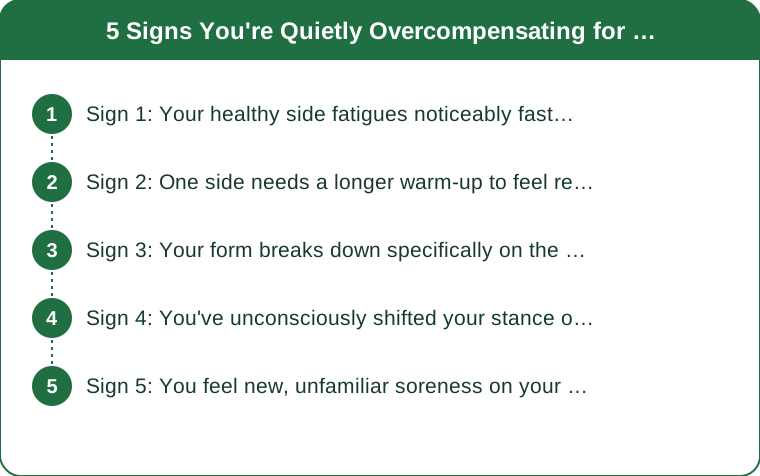
Sign 1: Your healthy side fatigues noticeably faster than it used to
If your uninjured side tires out before your injured side does in symmetric exercises, that’s a strong signal it’s been carrying more than its share of the load for longer than intended. This pattern often persists well after the injured side has technically cleared for full activity, since the compensation habit outlasts the actual physical need for it.
Comparing set-to-set fatigue between sides during simple bodyweight work is an easy way to actually notice this rather than just sensing something feels off.
Sign 2: One side needs a longer warm-up to feel ready
A side that consistently needs extra time or reps to feel loose and responsive before it performs well is often the side that’s been quietly compensating and hasn’t been given a chance to rebuild its own independent readiness. This is different from normal warm-up asymmetry and tends to be a consistent, repeatable pattern across sessions rather than a one-off.
Tracking which side ‘wakes up’ slower over a couple of weeks helps confirm whether this is a real pattern worth addressing.

Sign 3: Your form breaks down specifically on the healthy side under fatigue
It seems backwards, but form often deteriorates first on the overcompensating side, not the previously injured one, because it’s been working harder throughout the recovery period. If your technique noticeably worsens on your ‘good’ side before your rehabbed side under the same load, that’s a compensation pattern showing up under stress.
Filming both sides during a fatiguing set is a straightforward way to catch this objectively instead of relying on how a set simply feels.
Sign 4: You’ve unconsciously shifted your stance or grip to favor one side
Small postural shifts — standing with weight favoring one leg, gripping slightly asymmetrically — often develop during active injury and persist as habit long after they’re structurally necessary. These shifts redistribute load in ways that can create new strain patterns on joints that were never the original problem.
A quick mirror check of your resting stance, or asking a training partner to watch for asymmetry, often reveals a habit you’ve stopped consciously noticing.
Sign 5: You feel new, unfamiliar soreness on your healthy side
Soreness or minor strain showing up on the side that was never injured is one of the clearest warning signs of an active overcompensation pattern, since it means that side is now absorbing load it wasn’t originally built to handle at that volume. This is the sign most worth acting on quickly, since it often precedes an actual second injury rather than just following one.
At this stage, deliberately rebalancing training volume between sides — and consulting a physical therapist if the new soreness persists — is worth prioritizing over pushing through it.
TL;DR:
- Watch for uneven fatigue, slower warm-up on one side, and form breakdown on the healthy side under load
- Postural shifts (stance, grip) that started during injury often outlast the actual need for them
- New soreness on the previously uninjured side is the clearest sign compensation has become a risk
- Filming both sides under fatigue is more reliable than judging by feel alone
Catching these five signs early turns a quiet compensation habit into a fixable training adjustment — instead of into the second injury it was quietly building toward.
Keep Reading
This article is for general informational purposes only and is not medical advice. Always consult a qualified health professional for guidance specific to you.