5 Signs You're Comparing Your Comeback to the Wrong Timeline
Quick Answer: A comeback timeline built from someone else’s injury, a generic ‘X weeks to recovery’ article, or your own pre-injury fitness level is usually the wrong benchmark — real recovery timelines depend on injury specifics, age, training history, and rehab consistency that generic timelines don’t account for.
If your comeback feels disappointingly slow, the problem might not be your recovery — it might be the ruler you’re measuring it against. Here are 5 signs the timeline itself is the issue.

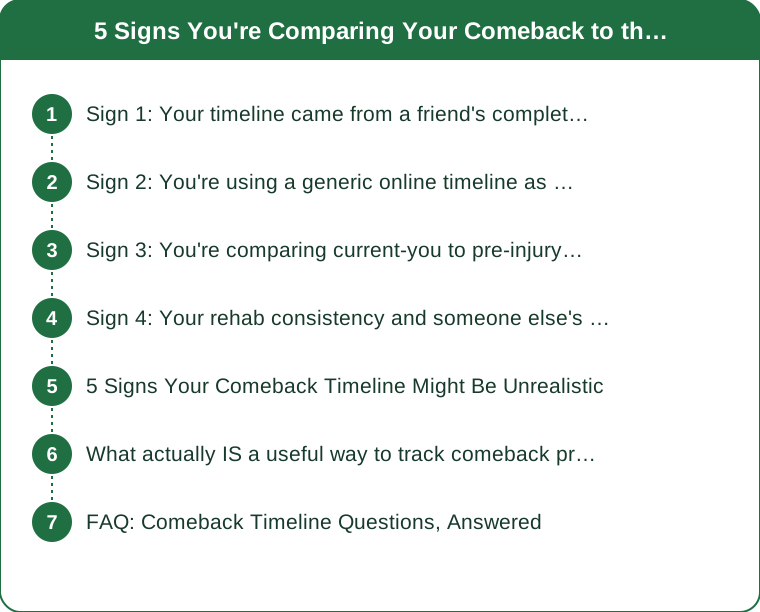
Sign 1: Your timeline came from a friend’s completely different injury
A friend’s 6-week ACL recovery and your 6-week timeline expectation for your own ACL injury can be wildly different situations — partial versus full tear, surgical technique, age, pre-injury conditioning, and rehab access all meaningfully change recovery speed. Comparing your progress to one specific other person’s outcome, rather than to a realistic range for your actual injury profile, sets up disappointment that has nothing to do with how well your recovery is actually going.
Sign 2: You’re using a generic online timeline as gospel
‘Ankle sprains heal in 2-6 weeks’ articles are describing a wide range for a reason — grade 1 sprains and grade 3 sprains are genuinely different injuries living under the same generic label. If you don’t know which end of a generic range your specific injury falls on, anchoring to the shorter end sets an expectation your actual injury may never have been positioned to meet.
Sign 3: You’re comparing current-you to pre-injury-you, not comeback-you to comeback-you
Measuring today’s single-leg squat against your pre-injury single-leg squat skips the entire relevant comparison — the question that actually reflects progress is how this week compares to two weeks ago in your recovery, not how it compares to a peak fitness state built over months or years before the injury happened at all.

Sign 4: Your rehab consistency and someone else’s aren’t actually comparable
A comeback timeline built around 3x-weekly physical therapy and daily home exercises moves differently than one with inconsistent appointment attendance and skipped home work — and that’s not a moral judgment, it’s just math. If your comparison benchmark assumed a level of rehab consistency you haven’t actually matched, the gap you’re seeing is explainable by that difference alone, not a sign something’s wrong.
5 Signs Your Comeback Timeline Might Be Unrealistic
1. It came from a single anecdote, not a range. 2. It ignores your injury’s specific severity grade. 3. It compares you to pre-injury peak fitness instead of week-over-week progress. 4. It assumes a rehab consistency you haven’t actually matched. 5. It doesn’t account for age or training history, both of which genuinely affect healing speed and are rarely mentioned in generic timeline content aimed at a broad audience.
What actually IS a useful way to track comeback progress?
Track specific, measurable markers against your own baseline: range of motion in degrees, pain level on a consistent 1-10 scale during the same test movement, or load tolerance (weight, reps) week over week. These personal markers, tracked consistently, tell you far more about real progress than any external timeline — because they’re measuring your actual trajectory, not comparing it to someone else’s starting point or injury.
FAQ: Comeback Timeline Questions, Answered
Why does my recovery feel slower than what I read online?
Generic timelines describe a range for injury severities and rehab consistency levels that may not match your specific situation — the gap is often explainable by those unaccounted variables, not slow healing.
Is it normal for recovery to not be linear?
Yes, genuinely — plateaus and even minor setback weeks are a documented normal part of rehab, not necessarily a sign anything has gone wrong.
How do I set a realistic comeback timeline for myself?
Ask your physical therapist or doctor for a range specific to your injury grade and situation, and track your own week-over-week markers rather than anchoring to a generic online number or someone else’s experience.
TL;DR:
- Generic timelines and other people’s specific injuries are usually the wrong benchmark for your comeback
- Compare this week to two weeks ago, not today to your pre-injury peak
- Account for rehab consistency differences when comparing your pace to anyone else’s
- Track your own measurable markers (range of motion, pain scale, load) instead of an external timeline
A slower-than-expected comeback is often a mismatched ruler, not a failed recovery — measure against your own trajectory, not someone else’s story.
Keep Reading
This article is for general informational purposes only and is not medical advice. Always consult a qualified health professional for guidance specific to you.