5 Real Signs You're Actually Ready for Full-Intensity Training Again — Not Just Pain-Free
Quick Answer: Being pain-free is necessary but not sufficient for a true return to full intensity — real readiness includes full pain-free range of motion under load, symmetrical strength between sides, confidence in the movement under fatigue, and the ability to handle sport-specific movement patterns, not just isolated exercises.
No pain is where most people stop checking. It’s actually just the first box on a longer list.

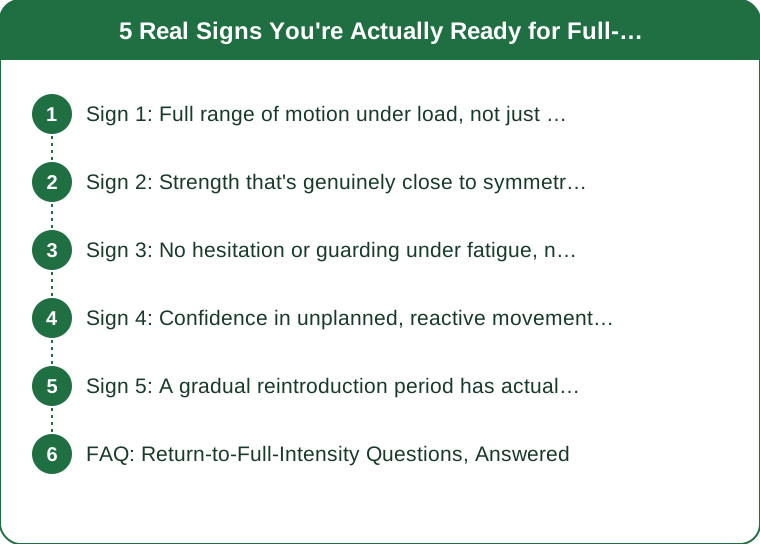
Sign 1: Full range of motion under load, not just at rest
Moving the joint through its full range with no resistance is a much lower bar than doing so under real load — a knee that flexes fully during a slow bodyweight lunge but tightens or hesitates under a loaded squat still has work to do before full intensity is appropriate.
Sign 2: Strength that’s genuinely close to symmetrical between sides
A single-leg or single-arm strength test comparing the injured side to the healthy side, ideally within about 90% of each other, is a far more objective marker than subjective confidence — many people feel ready well before their tested strength has actually caught up.
Sign 3: No hesitation or guarding under fatigue, not just when fresh
Movement quality that looks clean in the first few reps of a session can break down noticeably once real fatigue sets in — testing the movement pattern later in a session, when the body is tired, reveals whether stability is genuinely restored or was just holding up under easy, fresh-state conditions.

Sign 4: Confidence in unplanned, reactive movement, not just controlled reps
Controlled, planned repetitions in a gym setting are very different from the sudden direction changes, unexpected loads, or reactive movements common in sport or daily life — genuine readiness includes some exposure to less predictable movement before assuming full intensity is safe.
Sign 5: A gradual reintroduction period has actually happened, not just a decision to ‘go for it’
Even once the first four signs check out, jumping straight back to pre-injury intensity in one step skips the tissue adaptation period that a structured, several-week ramp-up provides — the checklist above tells you when to start ramping, not that a single all-out session is the appropriate next step.
FAQ: Return-to-Full-Intensity Questions, Answered
How long does the gradual ramp-up period after passing these checks usually take?
Many rehab professionals suggest a two to four week progressive ramp even after these signs are met, gradually increasing intensity and volume rather than jumping straight to pre-injury levels in one session.
Is it normal to still feel some nervousness even after meeting all five signs?
Yes, and it’s common — lingering psychological caution after physical readiness is well documented and typically fades with a few successful sessions at increasing intensity, rather than being a sign the body isn’t actually ready.
Should a physical therapist or trainer confirm these signs before returning to full intensity?
A professional assessment, especially for the strength symmetry and fatigue-resistance checks, is considerably more reliable than self-assessment alone and is worth the appointment before a full return, particularly after a significant injury.
TL;DR:
- Pain-free is the first checkpoint, not the finish line, for returning to full intensity
- Full range of motion under load and strength symmetry are more reliable markers than pain alone
- Movement quality should hold up under fatigue and in reactive, unplanned scenarios too
- A structured few-week ramp-up still matters even after all the readiness signs are met
Five real checkpoints beat one vague feeling — take the extra week to verify readiness properly rather than find out the hard way.
Keep Reading
This article is for general informational purposes only and is not medical advice. Always consult a qualified health professional for guidance specific to you.