5 Warning Signs Your Injury Comeback Is Moving Too Fast (A Visual Checklist)
Quick Answer: Five concrete signs your comeback is outpacing your actual healing: pain that returns after activity rather than during it, needing more warmup than before to feel normal, sleep disruption from the injured area, one-sided compensation patterns, and motivation that feels more like anxiety than excitement. Any two together is worth slowing down for.
The eagerness to get back to full training after time off is real, and it’s exactly what makes it hard to notice your own comeback moving faster than your body’s actually ready for. Here are 5 specific signs, one at a time.

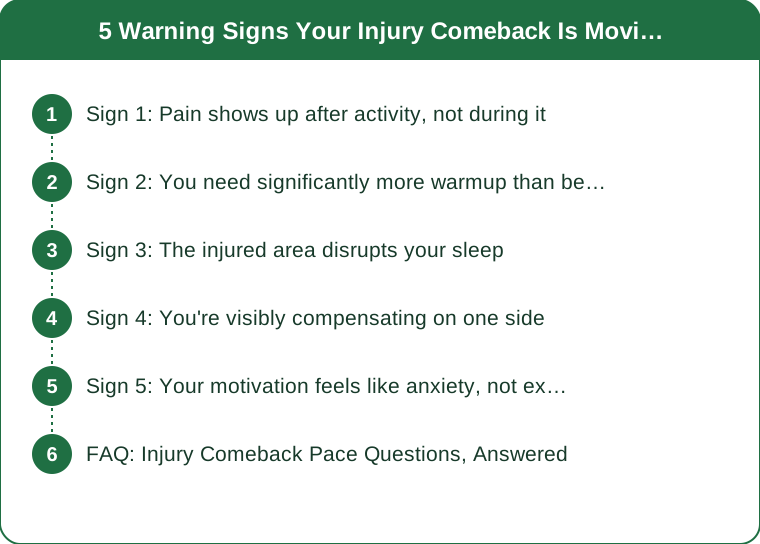
Sign 1: Pain shows up after activity, not during it
Pain-free during a session but sore or aching hours later, especially the next morning, is a classic sign of tissue still under repair being pushed past its current capacity — even when nothing felt wrong in the moment. This delayed pattern is easy to dismiss because it doesn’t interrupt the workout itself.
Sign 2: You need significantly more warmup than before to feel normal
If getting the injured area to feel functional now takes twice the warmup time it used to, that’s your body signaling it hasn’t fully returned to baseline capacity yet — pushing into full intensity before that warmup threshold is met increases reinjury risk.
Sign 3: The injured area disrupts your sleep
Aching or stiffness in the injured area that wakes you up or makes finding a comfortable position difficult is a stronger signal than daytime discomfort, since it reflects a resting, unloaded state where pain shouldn’t typically be present if healing is on track.

Sign 4: You’re visibly compensating on one side
Favoring the uninjured side during exercises that should be symmetrical (an uneven squat depth, an asymmetric running gait) means the injured side isn’t actually ready to bear its full share of the load — training through visible compensation risks overloading the healthy side while under-rehabbing the injured one.
Sign 5: Your motivation feels like anxiety, not excitement
Pushing pace out of fear of losing fitness or falling behind, rather than genuine readiness, is a psychological sign worth taking as seriously as a physical one — comeback decisions made from anxiety tend to skip steps that decisions made from confidence don’t.
FAQ: Injury Comeback Pace Questions, Answered
Is one of these signs alone a reason to stop training?
Not necessarily on its own, but it’s worth noting and monitoring — two or more of these signs together is a stronger signal to actually pull back pace rather than push through.
Who should I talk to if I notice several of these signs?
A physical therapist or the provider who guided your original injury treatment is the right resource — they can assess whether it’s a pace issue or something that needs reassessment.
How much should I actually scale back if I notice these signs?
A common approach is dropping back to your training volume from 1-2 weeks prior and holding there for a week before trying to progress again, rather than stopping entirely.
TL;DR:
- Pain appearing after activity, not during it, is a classic sign of tissue still under repair
- Needing much more warmup than before signals you haven’t returned to full baseline capacity
- Nighttime discomfort in the injured area is a stronger red flag than daytime soreness
- Two or more of these signs together is a real cue to scale back, not just push through
Keep Reading
This article is for general informational purposes only and is not medical advice. Always consult a qualified health professional for guidance specific to you.