5 Training Swaps That Keep You Moving Around an Injury
Quick Answer: Almost every injury permits training the uninjured side, the opposite half of the body, and the injured limb in a modified range or a different plane. Doing so preserves fitness, maintains the habit, and - through a genuine effect called cross-education - helps the injured side retain strength. Get clearance for the specific injury first, then swap rather than stop.
Five swaps below, each with what it preserves and what to watch for.

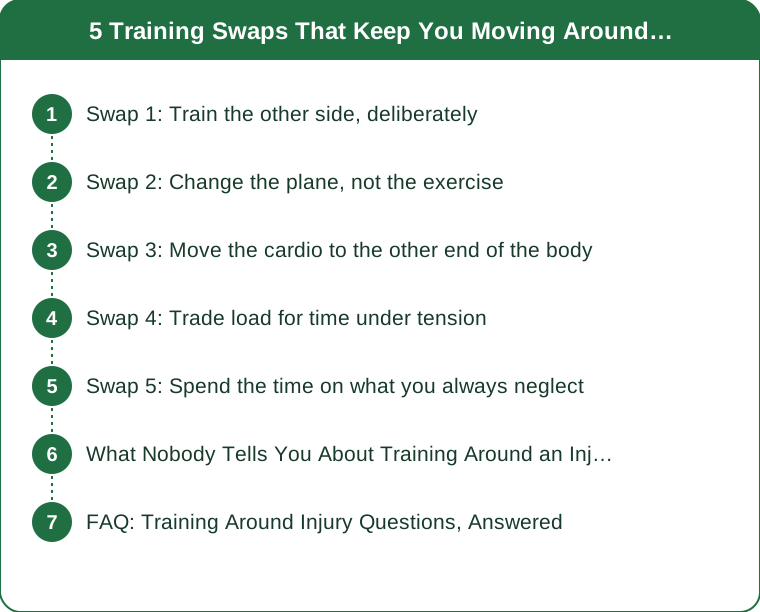
Swap 1: Train the other side, deliberately
The swap: if one limb is injured, train the uninjured one as normal or slightly more. Single-arm and single-leg versions of everything.
Why it works: this is not just about the healthy limb. Training one side produces measurable strength gains in the untrained opposite side - an effect called cross-education, and it is well documented. The mechanism is neural rather than muscular, and the practical result is that strength loss in an immobilised limb is significantly reduced when the other side keeps training.
It also preserves something that matters more than people expect: the pattern. Single-leg squats on the good side keep the movement familiar, so returning is a matter of restoring capacity rather than relearning.
What to watch: genuine asymmetry can develop if this runs for months rather than weeks, so the comeback should include a period of deliberate catch-up on the injured side. And be careful about the good side taking on too much - the uninjured limb frequently gets overloaded during a comeback, both in training and in daily life.
Practical version: single-arm dumbbell press, single-leg press, split squats on the good side, single-arm rows. Two to three sessions a week.
Swap 2: Change the plane, not the exercise
The swap: keep training the injured area, but in a direction or range that does not provoke it.
Why it works: most injuries are angle-specific and direction-specific. A shoulder that hurts overhead is frequently fine pressing horizontally. A knee that objects to deep flexion is often comfortable in a shallow range. The pain-free range is training territory, and abandoning it entirely is what produces the deconditioning people mistake for the injury itself.
This is where the difference between resting an injury and unloading it matters. Complete rest weakens tissue; controlled loading within tolerance is what most modern rehabilitation is built around.
What to watch: the boundary is pain, and it needs to be defined with whoever is treating you. A common working rule in rehab is that mild discomfort during is acceptable if it settles within 24 hours and does not worsen session to session - but that rule does not apply to every injury, and getting it wrong matters. Ask.
Practical version: knee pain in deep squats becomes box squats to a comfortable height. Overhead pressing becomes landmine pressing at an angle. Running becomes fast walking on an incline.
Swap 3: Move the cardio to the other end of the body
The swap: lower body injury becomes arm-driven cardio; upper body injury becomes leg-driven cardio.
Why it works: cardiovascular fitness declines faster than strength does - noticeable reductions appear within two to three weeks of stopping - and it is entirely preservable with a different modality. An arm ergometer, a hand cycle, or even seated boxing-style intervals produces a genuine cardiovascular stimulus without loading the legs at all.
For upper body injuries the options are wider: stationary cycling, stair climbing, incline walking, and leg-focused circuits all work with an arm in a sling, provided balance is not compromised.
What to watch: arm-only cardio produces higher heart rates at lower workloads than leg cardio, because the working muscle mass is smaller. Do not compare the numbers to your usual sessions - use effort instead.
Practical version: 20 to 30 minutes, two to three times a week, at an effort you could hold a conversation at, plus one interval session if you are cleared for it.

Swap 4: Trade load for time under tension
The swap: when you cannot use your normal loads, use slower tempos, longer holds, and higher repetitions with lighter weight.
Why it works: meaningful muscle stimulus is achievable at much lower loads than most people assume, provided sets are taken close to fatigue. A set of 25 with a light weight, taken near failure, produces a comparable growth stimulus to a heavy set of 8 - which is directly useful when heavy loading is off the table.
Isometric holds deserve specific mention: they build strength at the held angle with minimal tissue damage, and they are frequently tolerated when movement is not. For many tendon problems, isometrics are also used specifically for pain relief.
What to watch: high-rep work close to failure is genuinely demanding and produces real fatigue, so it needs the same recovery consideration as heavy work. And light does not mean careless - form deteriorating at rep 22 is still form deteriorating.
Practical version: three to four sets of 15 to 25 with a five-second lowering phase, or 30 to 45 second isometric holds, in whatever range is available.
Swap 5: Spend the time on what you always neglect
The swap: use the enforced change to build the thing that has been missing - mobility, single-leg balance, trunk work, breathing, or simply consistency.
Why it works: most training programmes have a known gap that never gets addressed because there is always something more urgent. An injury removes the urgent thing and creates a window. People who use it well frequently come back better than they were, not just recovered.
There is also a psychological dimension worth naming. An injury comeback is largely an exercise in maintaining identity as someone who trains, and having a productive focus - rather than a holding pattern - makes the whole period considerably easier.
What to watch: the temptation to turn this into a project so ambitious that it becomes its own stressor. The goal is a useful use of the window, not a second full programme.
Practical version: pick one thing. Ten minutes of hip mobility daily, or a proper trunk programme twice a week, or 15 minutes of single-leg balance work. One thing, done consistently for the duration.
What Nobody Tells You About Training Around an Injury
Strength declines slower than you fear and cardio declines faster than you expect. Meaningful strength loss takes several weeks; cardiovascular fitness starts declining within about two. That asymmetry should shape your priorities - if you can only do one thing, do the cardio substitute.
The uninjured side is at elevated risk. It is doing more work in the gym and in daily life - carrying, balancing, compensating. A surprising proportion of comeback problems are new injuries on the good side. Do not let the compensation run unmanaged.
Movement quality drifts while you are away and nobody notices until they return. A few weeks of altered patterns produces compensations that persist after the injury resolves. Filming yourself occasionally during the comeback catches this early.
The comeback goes better when you never fully stopped. This is the strongest argument for everything above. People who maintained some training return faster, with less deconditioning, and with more confidence in the injured area - and confidence turns out to be one of the better predictors of a successful return.
Get it cleared, specifically. Generic advice about training around injuries cannot account for your injury. A physiotherapist or doctor can tell you which of these five swaps applies to your situation and which is a bad idea, and that conversation is worth having before you start rather than after something aggravates. This is general information, not medical advice.
FAQ: Training Around Injury Questions, Answered
Is any pain during exercise acceptable?
It depends entirely on the injury, which is why this needs to be a conversation with whoever is treating you. A commonly used framework allows mild discomfort that settles within 24 hours and does not increase week to week - but it is not universal, and applying it to the wrong injury causes harm.
How much fitness will I lose?
Less than you think if you keep training around it. With a reasonable substitute programme, most people maintain the majority of their cardiovascular fitness and lose little strength over four to six weeks.
Should I train the injured area at all?
Usually yes, in some form, once cleared - controlled loading is central to modern rehab and complete rest weakens tissue. The specifics matter enormously, so get them from your physio rather than from an article.
What if training around it makes me obsess about the injury?
A real and underrated problem. If the modified training is making things worse mentally, changing the focus entirely - taking up something unrelated for a few weeks - is a legitimate choice. The goal is to come back whole, and that includes the part that has to want to.
TL;DR:
- Train the uninjured side hard - cross-education means it genuinely helps the injured side retain strength.
- Change the plane or the range rather than abandoning the movement. The pain-free range is training territory.
- Swap the cardio to the other end of the body. Cardiovascular fitness declines fastest and is the easiest to preserve.
- Use tempo, high reps close to failure, and isometric holds when load is unavailable.
- Spend the window on the one thing your programme always skipped - and get every swap cleared for your specific injury.
The comeback is shorter for people who never fully stopped. That is the whole argument.
Keep Reading
This article is for general informational purposes only and is not medical advice. Always consult a qualified health professional for guidance specific to you.