5 Things to Track During a Comeback That Are Not Pain
Quick Answer: Most people run a comeback on a single metric - does it hurt - and it is the worst available one. Pain is delayed, influenced by sleep and stress, and often absent right up until you have done too much. Better signals: next-morning stiffness duration, symmetry under load, how quickly capacity returns between sessions, confidence in the movement, and whether you are compensating. Track these and you get days of warning instead of hours.
Five things, each of which takes under a minute to log.

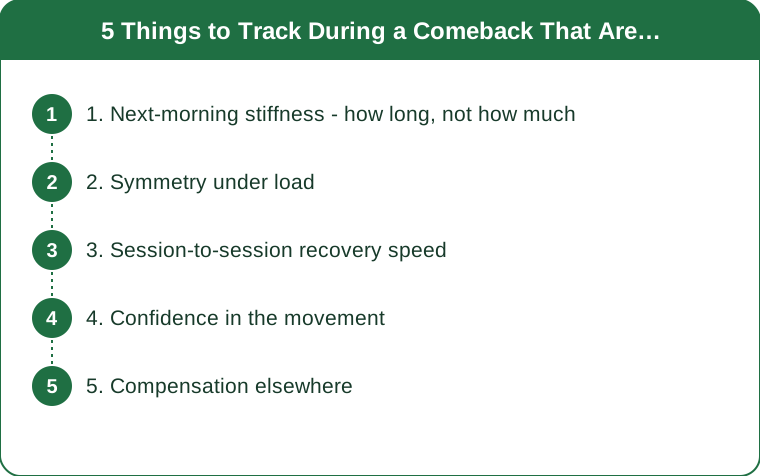
1. Next-morning stiffness - how long, not how much
What to track: how many minutes it takes for the injured area to feel normal after you get out of bed.
Why it beats pain intensity. Stiffness duration is a much more stable signal than pain severity, which swings with sleep, stress, weather, and mood. Duration is comparatively honest - the same amount of morning stiffness lasting 5 minutes rather than 40 tells you something specific about the tissue.
The rule of thumb that works: stiffness that resolves within about 30 minutes of moving is generally acceptable progress. Stiffness lasting into the afternoon means the last session was too much.
The trend is the data, not the day. One stiff morning means nothing. Three consecutive mornings of longer stiffness than the week before means back off, and that pattern typically appears two or three days before pain would have told you anything.
2. Symmetry under load
What to track: whether the injured side does the same amount of work as the other one when you are not thinking about it.
The simplest test: a bodyweight squat filmed from the front, or a single-leg sit-to-stand from a chair counted on both sides. Compare the numbers rather than the sensations - sensation lies constantly during a comeback.
Why it matters: the body will happily complete a movement by shifting the work to the uninjured side, and it does this without any conscious input. You feel fine because the injured side is not doing very much. That is not recovery, it is an efficient avoidance strategy, and it is how people develop a second problem on the other side.
A workable target: most return-to-sport frameworks look for the injured side reaching roughly 90 percent of the uninjured side on relevant tests before returning to full intensity. Test it every two weeks rather than every session.

3. Session-to-session recovery speed
What to track: how many days it takes before you feel ready to repeat the same session.
This is the clearest measure of whether your capacity is actually rebuilding. Early in a comeback, a moderate session might need three days. When that same session needs only one, you have genuinely gained capacity - and that is the signal to progress, far more reliable than a calendar plan.
Why calendar-based progression fails: it assumes a rate of healing that varies enormously between people, injuries, ages, and how well you sleep. A plan that says week four means squats regardless of how week three went is not a plan, it is a guess.
The practical version: after each session, note a single number for how ready you feel the next day and the day after. When the day-after number stops being bad, add load. When it gets worse across a week, hold.
4. Confidence in the movement
What to track: on a scale of one to ten, how much you trust the injured part during the movement that scares you most.
This is not a soft metric. Fear of re-injury is one of the strongest predictors of whether people return to their previous activity level, and it is well documented in return-to-sport research. It also predicts re-injury, partly because a hesitant movement is a badly executed one.
What it looks like in practice: you land differently, you brace before you load, you avoid the direction that caused the injury without noticing. The body follows the hesitation, and the hesitation is what makes the movement risky - not the tissue.
How to move it: exposure at intensities you are confident with, repeated until the confidence rises, then a small step up. Confidence is trained the same way capacity is - progressively. Jumping straight to the frightening version because the physiotherapy has finished is how people end up back at the start.
If confidence is stuck while capacity is clearly improving, that gap is worth raising with your physiotherapist - it is a recognised part of rehabilitation, not a character flaw.
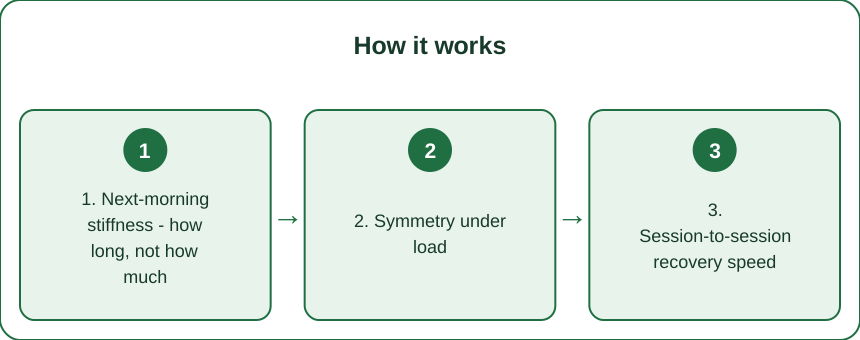
5. Compensation elsewhere
What to track: new aches in places that were never injured.
This is the signal that catches what the others miss. A calf strain comeback that produces hip tightness on the same side, or shoulder work that starts irritating the neck, is telling you that something is being loaded to protect something else.
The pattern to watch for: a new complaint that appears within two weeks of a progression, on the same side or the opposite one, in a joint above or below the injury. The injured area feels fine, which is exactly why this gets missed.
What to do about it: it is usually not a reason to stop, but it is a reason to look at how the movement is being performed. Film it. Compensation is almost always visible and almost never felt.
What nobody tells you about comebacks: the most common way they go wrong is not a dramatic re-injury. It is a slow accumulation of compensation that turns one injury into a pattern, and the only reliable way to catch it is to keep half an eye on the places that do not hurt.
TL;DR:
- Pain is delayed and noisy - it tells you about yesterday, and often not even that
- Track morning stiffness duration; under 30 minutes is progress, into the afternoon means back off
- Test symmetry every two weeks and aim for around 90 percent of the uninjured side before full intensity
- Recovery speed between identical sessions is your real progression trigger, not the calendar
- Watch confidence and watch for new aches elsewhere - compensation is visible on video and invisible to feel
Write down two numbers after each session: morning stiffness minutes and next-day readiness. That is under a minute of work and it turns a comeback from guesswork into something you can actually steer.
Keep Reading
This article is for general informational purposes only and is not medical advice. Always consult a qualified health professional for guidance specific to you.