5 Comeback Conversations Worth Having Before You Return
Quick Answer: Comebacks fail on ambiguity more than on physiology. Before you return, get specific answers to five things: what exactly is cleared, what pain is acceptable, what the progression rate is, what your training group needs to know, and what your own stopping rules are. Each is a five-minute conversation that prevents weeks of setback.
You got cleared. Which turned out to mean something different to you than it did to the person who cleared you.
Most comeback problems start there — not in the tissue, but in the gap between what was said and what was heard.

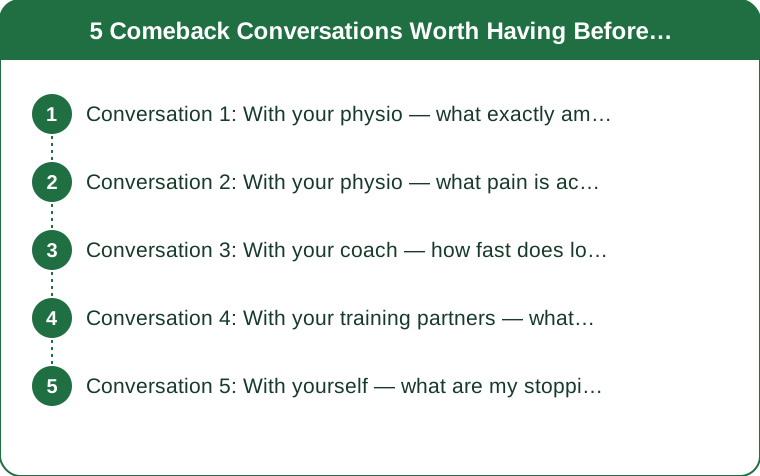
Conversation 1: With your physio — what exactly am I cleared for?
Cleared is not a single thing, and assuming it is causes more re-injuries than any training error.
Ask specifically:
- What movements am I cleared for, and which am I not?
- At what intensity, and for how long?
- What’s the next milestone, and what does reaching it look like?
- What would make you want to see me again?
The gap this closes is real. A physio clearing you for running often means easy running on flat ground in a structured progression. Many people hear it as running. Those are very different weeks, and one of them ends in a repeat appointment.
Ask for it in writing, or write it down in the appointment and read it back. Ninety seconds of confirmation beats a re-injury, and any good physio will appreciate the question — vague clearance is a problem for them too.
Conversation 2: With your physio — what pain is acceptable?
The single most useful piece of information in a comeback, and it’s frequently not discussed at all.
Complete absence of sensation is an unrealistic standard for most returns, and waiting for it means never progressing. But some discomfort is normal is uselessly vague, and it’s the sentence people use to justify training through things they shouldn’t.
Ask for specifics:
- On a 0-10 scale, what level is acceptable during activity?
- What about the next morning — and how long should any soreness last?
- What kind of pain is a stop sign rather than a normal one? Sharp? Radiating? Located somewhere new?
- Should swelling change anything?
Many clinicians use a rough traffic-light approach — low-level discomfort that settles within a day is generally acceptable, while higher pain or symptoms lasting into the next day means back off. Get your own numbers rather than borrowing that one, because the right threshold depends on your injury and stage.
Once you have it, you can make decisions mid-session instead of guessing.

Conversation 3: With your coach — how fast does load go up?
The most common comeback mistake is progressing well for three weeks and then jumping too fast in week four, because things felt good.
What to establish together:
- What’s the weekly increase — volume, intensity, or both, and never both at once
- What are the checkpoints where we reassess?
- What’s the plan for a bad week, and how do we step back without starting over?
- When do I rejoin normal sessions rather than modified ones?
The 10% weekly guideline is a reasonable starting frame, though it’s a rule of thumb rather than a law — and it’s most useful because it forces the conversation about rate, which otherwise doesn’t happen at all.
The part people forget: agree on what a setback looks like before it happens. Deciding mid-flare-up, while frustrated, produces worse decisions than agreeing in advance that a flare means dropping back two weeks in the progression and rebuilding.
Conversation 4: With your training partners — what I need from you
Underrated, slightly awkward, and it prevents a specific and common failure: getting pulled back into full intensity by group dynamics.
Worth saying out loud:
- I’m on a modified plan for the next few weeks
- I’m not racing anyone right now, so don’t wait for me and don’t push the pace on my account
- If I stop early, it’s planned rather than a problem
- Please don’t ask me every session how it’s feeling — I’ll tell you if something changes
That last one is small and matters more than it sounds. Being asked about an injury repeatedly keeps your attention fixed on it, and one of the harder parts of a comeback is learning to stop monitoring a body part constantly.
For team sports especially: have this conversation with whoever makes decisions during a session. In the moment, in a game, nobody remembers you’re on a modified plan unless someone whose job it is knows.
Conversation 5: With yourself — what are my stopping rules?
Decided in advance, in writing, while you’re calm. This is the one that holds when the others don’t.
Write down, before your first session back:
- The specific pain level or symptom that ends a session immediately
- The number of consecutive good sessions required before you progress
- What you’ll do on a day you feel great — spoiler: the plan, not more than the plan
- Who you’ll contact if something changes, and at what point
Why this needs to be written: mid-session, warmed up, feeling good and impatient after weeks off, you are the least reliable judge of your own risk. A rule written on a calm Tuesday is worth far more than a judgment call made in the moment.
The hardest one to hold is the good-day rule. Feeling great is the most common trigger for the too-much-too-soon jump, because it reads as evidence you’re ready. It isn’t — tissue healing timelines run on their own schedule regardless of how good a given day feels.
This is general information, not medical advice. Any return-to-activity plan should be built with the clinician who treated your injury.
TL;DR:
- Get cleared defined specifically — which movements, what intensity, what’s next.
- Ask for a numeric pain threshold during and after, plus what counts as a stop sign.
- Agree a progression rate and a written plan for setbacks before one happens.
- Tell your training partners what you need, including not being asked every session.
- Write your own stopping rules while calm, especially the rule for days you feel great.
Have the first two before your next session. Ten minutes of specific questions is the highest-return thing in any comeback, and it’s the part that costs nothing.
Keep Reading
This article is for general informational purposes only and is not medical advice. Always consult a qualified health professional for guidance specific to you.