5 Comeback Mistakes People Make the Moment the Pain Stops
Quick Answer: The first pain-free weeks are high risk because pain resolves well before tissue capacity returns. Tendon and muscle remodelling continues for weeks to months after symptoms settle, so feeling fine is not the same as being ready. The five mistakes below all share one root: treating the absence of pain as permission to return to previous load.
Two weeks with no pain. You feel completely normal.
This is precisely the window where most reinjuries happen, and the reason is not carelessness.
Here are the five specific mistakes, and the fifth one catches even careful people.

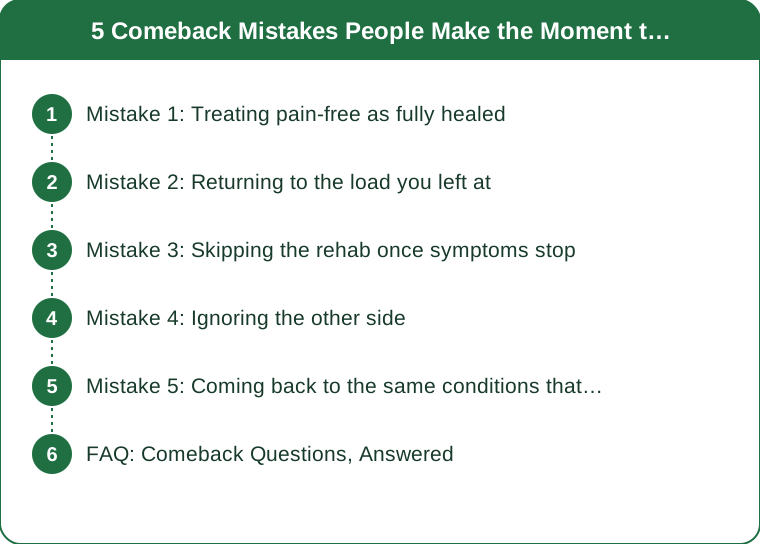
Mistake 1: Treating pain-free as fully healed
Pain is a poor proxy for tissue capacity, and this is the single misunderstanding underneath every other mistake on the list.
Pain typically resolves in the early phase of healing, while the remodelling that restores tissue strength continues for considerably longer — weeks for muscle, and often months for tendon. Tendon in particular is slow, and its capacity to tolerate load lags well behind how it feels.
What this means practically: the fortnight after pain stops is when tissue is most vulnerable to a load spike, because you feel capable of doing what you used to do and the tissue is not yet able to absorb it.
What to do instead: use load tolerance rather than pain as your guide. Can you do the movement, at the intended load, and feel the same the next morning? That is the test. Feeling fine during the session is necessary but nowhere near sufficient.
The 24-hour rule is the practical version: judge every session by how the area feels the following morning, not by how it felt at the time.
Mistake 2: Returning to the load you left at
Your body remembers what it used to do, and your tissue does not.
After weeks of reduced activity, muscular strength, tendon stiffness and tissue tolerance have all decreased, along with the coordination that distributes load properly. Returning at the load you stopped at is a substantial spike relative to what your tissue has recently handled.
What to do instead: return at a fraction of previous load — commonly around 50 percent of your pre-injury volume — and build back with a modest weekly increase. Slower than feels necessary is the correct pace, because the cost of being too slow is a few extra weeks and the cost of being too fast is a repeat of the whole injury.
Change one variable at a time. Volume, intensity, frequency, surface and footwear are five different things, and increasing two at once means you cannot tell what caused a flare.
The specific trap: feeling good in week one and using that as evidence you can skip the graduated build. Week one always feels good — that is the nature of the problem.
Mistake 3: Skipping the rehab once symptoms stop
Adherence to rehab drops sharply the moment pain resolves, and this is one of the better-documented behaviours in the field.
The exercises stop feeling necessary because their most obvious effect — pain reduction — has already happened. But the strength and capacity work is what prevents recurrence, and it usually needs to continue well beyond symptom resolution.
What to do instead: keep the rehab programme running for at least as long again after symptoms resolve, and ideally fold the key exercises permanently into your training. Many recurring injuries are genuinely recurring adherence problems.
Reduce the frequency rather than stopping entirely. Dropping from daily to twice a week is a sustainable transition. Dropping to zero is how the same injury reappears in four months.
The specific trap: the exercises feel too easy now, which is taken as evidence they are no longer needed. If they are too easy, progress the load — do not delete them.

Mistake 4: Ignoring the other side
Weeks of compensation leave measurable changes in the uninjured side too, and it is a common site of the next problem.
While you were protecting one limb, the other took extra load, often with an altered movement pattern. Meanwhile the injured side lost strength that may still be significantly behind even when it feels normal — asymmetries of 10 to 15 percent or more are common at the point people feel fully recovered.
What to do instead: test both sides. Single-leg or single-arm work reveals differences that bilateral movements hide completely, because the stronger side quietly compensates. A single-leg heel raise test, a step-down, or a simple single-arm press will usually expose a gap you did not know was there.
Include unilateral work in the return programme specifically so the asymmetry gets addressed rather than accommodated.
The specific trap: a squat or a bilateral press feeling normal, which it will, because the good side does more of the work without you noticing.
Mistake 5: Coming back to the same conditions that caused it
The injury happened in a context, and returning to an unchanged context is a plan to repeat it.
This is the mistake that catches careful people — someone can do everything else on this list correctly and still return to the same training spike, the same worn-out shoes, the same seven-day-a-week schedule, or the same rapid mileage jump that caused the problem originally.
What to do instead: identify the specific cause honestly. Was it a load spike? A change of surface or footwear? A period of poor sleep or under-eating? Returning after a break without addressing it means the same conditions are waiting.
Look at the four weeks before the injury, not the day of it. Injuries rarely originate in the session where they appeared. The load pattern in the preceding month is usually where the answer is.
Build the fix into the return plan. If the cause was a rapid volume increase, the return plan needs a volume cap. If it was worn footwear, replacing it is part of the rehab, not an afterthought.
Seasonal note: this is the specific window where autumn causes trouble. Training moves indoors, surfaces change, mileage often jumps as the weather cools, and daylight shrinks the available training slots. A comeback landing in that transition needs the surface and volume changes accounted for deliberately.
If pain returns, is sharp, or is localised to bone, stop and get it assessed. This is general information, not medical advice.
FAQ: Comeback Questions, Answered
How long after pain stops until I can train normally?
It depends on the tissue — muscle recovers faster than tendon, which can take months. A graduated build of several weeks is typical even for straightforward injuries.
Is some discomfort acceptable during rehab?
Often yes. Many rehab protocols allow mild discomfort that settles within 24 hours. Sharp pain, or pain that worsens the next day, is the line.
How fast should I increase load?
Modest weekly increases with a check on how you feel the following morning. The precise percentage matters less than changing one variable at a time and monitoring the response.
Should I get cleared before returning?
For anything significant, yes — objective return-to-sport testing catches asymmetries that feel invisible. It is worth it particularly for lower limb injuries.
What if I flare it up again?
Drop back a step rather than stopping entirely, and hold there until it settles. A small flare is information about dose, not evidence the comeback failed.
How do I stop being afraid of the movement?
Graded exposure — start well below the threshold and build predictably. Confidence follows successful repetitions, and it lags behind physical recovery for most people.
TL;DR:
- Pain resolves before capacity returns. Tendon remodelling continues for months after symptoms stop.
- Return at around 50 percent of previous load and build gradually, changing one variable at a time.
- Keep the rehab going well past symptom resolution — dropping it is why injuries recur.
- Test both sides separately. Bilateral movements hide asymmetries the good side is covering.
- Fix the conditions that caused it, or you are scheduling a repeat.
Judge every session by how it feels the next morning. That single habit prevents most of these.
Keep Reading
This article is for general informational purposes only and is not medical advice. Always consult a qualified health professional for guidance specific to you.