5 Comeback Milestones That Are Not Load or Reps
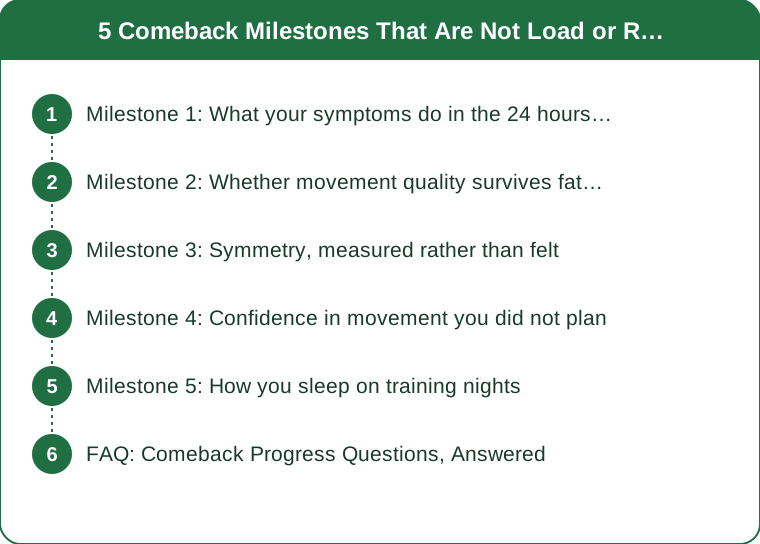
Quick Answer: Load and reps are lagging indicators - they improve last and they hide problems. The markers that tell you the truth are symptom behaviour over 24 hours, movement quality under fatigue, symmetry between sides, confidence in unplanned movement, and sleep after training days. Track those five and you will make better decisions than any percentage-based rehab chart, because they respond within days rather than weeks.
Here is what to watch for in each, and what a good week actually looks like.

Milestone 1: What your symptoms do in the 24 hours after
This is the single most informative marker in a comeback, and it is not what you feel during the session.
Pain during exercise up to about 3 out of 10 is generally acceptable in most rehab contexts. What matters is what happens afterwards.
The green pattern: any increase settles within 24 hours and your next session starts at the same baseline as the last one. That is a body that is adapting.
The yellow pattern: symptoms stay elevated for 24 to 48 hours. One yellow week is information, not an emergency - hold the current load rather than progressing, and reassess.
The red pattern: symptoms are worse at 48 hours, or your baseline creeps up week over week. That is too much, regardless of how the session felt.
Track it simply. A number out of 10 the morning after, in a notes app, every time. Two weeks of that data beats any amount of remembering, because memory reliably smooths out exactly the pattern you need to see.
Milestone 2: Whether movement quality survives fatigue
Anyone can look good on rep one. The comeback is real when rep eight looks like rep one.
Film one working set a week from the same angle. Not every set - one set, same exercise, same camera position. The comparison across four weeks is worth more than any single session’s feeling.
What to look for: the knee that drifts inward on later reps, the hip that shifts toward the uninjured side, the shoulder that shrugs to finish a press, the trunk that rotates to compensate.
Compensation under fatigue is the earliest sign that capacity has run out - it appears well before pain does, which makes it genuinely predictive.
The rule that keeps people out of trouble: end the set when quality degrades, not when the rep target is met. A prescribed 3 sets of 10 that becomes 3 sets of 7 clean reps is a successful session, and treating it as a failure is how people re-injure themselves at week five.
Milestone 3: Symmetry, measured rather than felt
Feeling symmetrical and being symmetrical are different things, and the gap is usually large.
Single-leg tests are the most useful, and free. A single-leg sit-to-stand from a chair - count reps per side, aiming for within 10% - or a single-leg calf raise to fatigue, same target.
Balance with eyes closed for 30 seconds per side reveals control differences that open-eyed testing hides completely.
Grip strength is worth testing for upper-limb comebacks and often lags long after the injury feels resolved.
Retest every 2 to 3 weeks, same conditions, same time of day. A 10% side-to-side difference is a reasonable target before returning to sport or high-intensity training, and most people are considerably further off than they assume when they first measure.
The reason this matters: asymmetry that persists into full training does not stay a local problem. It becomes the reason something else hurts three months later.

Milestone 4: Confidence in movement you did not plan
This is the one nobody tracks and everybody feels.
Planned movement is easy to protect. You know the rep is coming, you brace, you control the tempo. Unplanned movement is where confidence actually shows - stepping off a kerb awkwardly, catching a bag as it slips, changing direction because a dog appeared.
The honest test: do you still brace before ordinary daily movements? Do you avoid stairs on the injured side? Do you take the same route to avoid the uneven bit of pavement?
Reduced-confidence behaviour outlasts tissue healing by months, and it maintains exactly the movement patterns that caused the problem.
How to progress it deliberately: add small amounts of unpredictability once symptoms are stable - varying tempo, reactive step-downs, light ball catches while single-leg standing, walking on grass or gravel rather than smooth floor. Start with 5 minutes at the end of a session and build.
Late summer into autumn is a genuinely useful window for this: wet leaves, darker mornings, and uneven ground all arrive together, and the comeback that has never met an unpredictable surface tends to meet one at the worst moment.
Milestone 5: How you sleep on training nights
Sleep is a surprisingly sensitive readout of whether your training load is appropriate.
Sleeping normally after a session suggests the load was within your current capacity. Waking with the injured area aching, or struggling to settle after an evening session, generally means you overshot.
Elevated resting heart rate the morning after - if you track it - points the same direction. A rise of more than about 5 to 7 bpm above your normal is worth respecting.
Sleep is also where the repair happens. Tendon and muscle remodelling depend on it, so a comeback conducted on 5 hours a night progresses measurably slower regardless of how good the programme is.
The practical adjustment: if evening sessions consistently wreck your sleep, move the harder session earlier in the day or reduce it. This is a load management problem, not a discipline problem.
One broader note, because it saves people months: comebacks are not linear. Good weeks and flat weeks alternate, and a flat week following a good one is normal rather than a setback. Judge the trend across a month, not across two sessions. If the four-week trend is flat or downward across these five markers, that is when it is worth getting reassessed by a physiotherapist.
FAQ: Comeback Progress Questions, Answered
How much pain is acceptable during rehab exercise?
Commonly up to about 3 out of 10 during, provided it settles within 24 hours and your baseline does not creep up week to week. The 24-hour response matters more than the number in the moment.
When can I stop doing rehab exercises?
Usually later than people think. Keeping two or three key exercises in your normal training - typically single-leg or single-arm work - is what stops recurrence, and it costs about ten minutes a week.
Why does my injured side still feel weak after it stopped hurting?
Strength and neuromuscular control lag behind pain resolution by weeks or months. Pain-free is a milestone, not the finish line, which is exactly why symmetry testing is worth doing.
Should I train the uninjured side while I recover?
Yes. Training one side produces measurable strength retention on the other through cross-education, and it maintains the habit and the fitness base you will need.
This is general information, not medical advice. Work with a physiotherapist for an individual rehabilitation plan.
TL;DR:
- Load and reps are lagging indicators - they improve last and they mask problems.
- Track instead: 24-hour symptom response, movement quality under fatigue, measured side-to-side symmetry, confidence in unplanned movement, and sleep on training nights.
- Green is settling within 24 hours; red is worse at 48 hours or a creeping baseline.
- Judge the four-week trend, not two sessions - comebacks are genuinely non-linear.
The reason these five markers work is that they respond within days, while the numbers on your training log take weeks. That gives you the chance to adjust before something goes wrong rather than explaining afterwards why it did.
Keep Reading
This article is for general informational purposes only and is not medical advice. Always consult a qualified health professional for guidance specific to you.