5 Comeback Adjustments When Training Moves Indoors
Quick Answer: Moving a comeback indoors changes four things at once: the surface gets harder and grippier, the temperature drops so warm-ups need to be longer, the movement patterns shift from long steady efforts to shorter repeated ones, and the light and schedule change makes consistency harder. Each of those raises load on healing tissue in a way that is easy to miss because the training volume on paper did not change. Extend the warm-up, reintroduce the new surface gradually, and hold your progression flat for two weeks through the transition.
The rehab went well. You did it through August on grass and trail, in warm weather, with plenty of daylight.
Now the training moves inside, and two weeks later something is aching that had stopped aching. The plan did not change. Almost everything around the plan did.

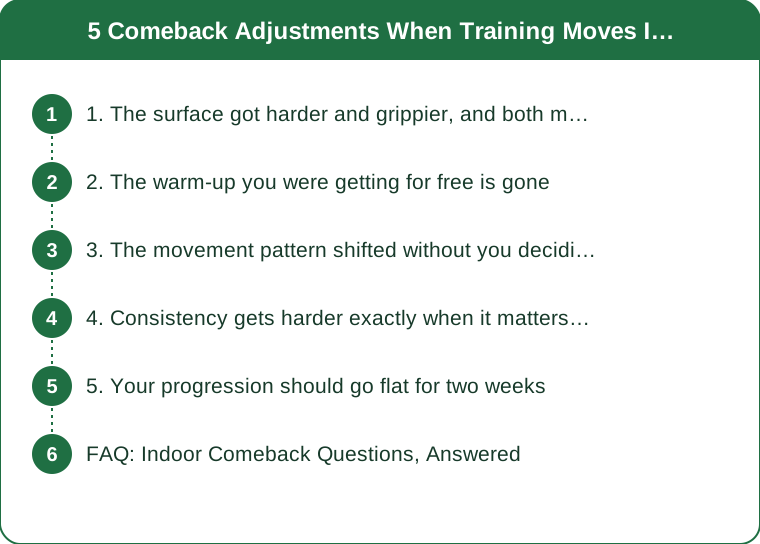
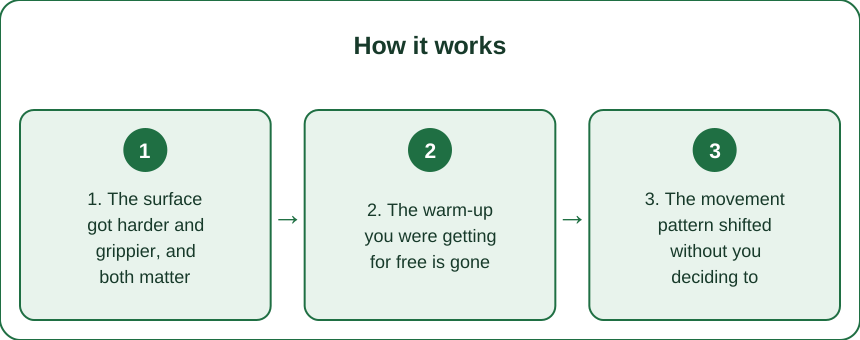
1. The surface got harder and grippier, and both matter
Grass and trail absorb impact and allow a small amount of foot slide. Hardwood, rubber gym flooring, and treadmill belts do neither in the same way.
Harder surfaces increase peak impact forces transmitted through the foot, shin, knee, and hip. For tissue that is 80 percent healed, that difference is meaningful even though the movement looks identical.
Grippier surfaces change your deceleration profile. On grass, a hard stop involves a small controlled slide that spreads the deceleration over more time. On a gym floor, there is no slide, so the whole deceleration happens through the joint. This is why the first few indoor sessions after an outdoor summer produce a distinctive kind of soreness in the quads and knees.
What to do: treat the surface change as a training variable in its own right. Introduce it at reduced volume, roughly 50 to 60 percent of what you were doing outdoors, and build back over two to three weeks. Do not change the surface and increase the load in the same week.
One practical mitigation: for the first sessions indoors, choose footwear with more cushioning than you used outdoors, and reassess after a few weeks.
2. The warm-up you were getting for free is gone
In August, you arrived at the session already warm. Ambient temperature did a share of the work, and the walk or cycle to get there did more.
In October, you arrive from a cold commute into a gym that may itself be cool, and your tissue temperature is lower than it has been at the start of a session in months.
Why this matters specifically for a comeback: healing tissue is stiffer than uninjured tissue for an extended period after the pain resolves. Scar tissue and remodeling collagen have different mechanical properties from the original. Starting cold means starting stiffer than your uninjured baseline was, on tissue that was already stiffer.
What to do:
- Double the warm-up. If you were doing 5 minutes outdoors in summer, do 10 to 12 indoors in fall.
- Warm the injured area specifically. General cardio raises core temperature but does relatively little for a specific ankle or shoulder. Add targeted movement for the region.
- Layer for the first 15 minutes and remove as you warm, rather than starting in what you will finish in.
- Move the harder work later in the session than you did in summer.
3. The movement pattern shifted without you deciding to
This one is easy to miss because it is not on the training plan.
Outdoor training in summer skews toward long, continuous, relatively steady efforts. Indoor training skews toward shorter, repeated, higher-intensity ones: intervals, classes, circuits, court sports.
Repeated high-intensity efforts load tissue differently from continuous moderate ones. More accelerations, more decelerations, more direction change, higher peak forces, and less time at any single steady load. For a healing tendon or a recovering joint, peak force and rate of loading matter more than total volume.
So your weekly hours can stay identical while the actual demand on the injured tissue rises substantially.
What to do: count the hard efforts, not the hours. If your outdoor week had 3 accelerations above 80 percent and your indoor week has 60, that is the change to manage, regardless of what the duration column says. Reintroduce high-intensity efforts in small numbers, and add them before you add duration.

4. Consistency gets harder exactly when it matters most
The behavioral part, and it affects outcomes as much as the mechanical parts do.
Daylight shrinks, the commute gets darker, and the friction of getting to training rises. Comeback programs are particularly vulnerable to this because the sessions are often unglamorous. Nobody is excited about their fourth week of single-leg balance work in the dark.
Why inconsistency is worse for a comeback than for normal training: tissue adaptation to load requires repeated stimulus. A gap of ten days does not just pause progress, it partially reverses the tendon and connective tissue adaptations you built, which respond to load frequency more than to load magnitude.
What to do:
- Shrink the sessions rather than skipping them. A 15-minute version done four times a week beats a 45-minute version done once.
- Move the session earlier if darkness is the barrier. Morning is more protected than evening once the light goes.
- Front-load the rehab work. Do the specific exercises first in the session, while motivation and time are both still available.
- Keep a log with a streak. Comebacks are long enough that the sense of progress has to come from somewhere other than performance.
5. Your progression should go flat for two weeks
This is the single most useful adjustment and it is the one people resist, because it feels like standing still.
When four variables change at once, surface, temperature, movement pattern, and schedule, the correct response is to hold everything else constant while your tissue adapts to the new environment.
Practically:
- Keep your current loads, distances, and intensities exactly where they are for two weeks after the transition indoors
- Add nothing. No new exercises, no new volume, no new intensity
- Use the two weeks to re-establish the warm-up and the schedule
- Then resume progressing from where you were
What this costs you: roughly two weeks of progression, which on a comeback timeline of several months is close to nothing.
What it prevents: the setback that follows a re-aggravation, which is typically three to six weeks and comes with a psychological cost that is often larger than the physical one.
The signal to watch through the transition: morning stiffness in the injured area that lasts longer than about 30 minutes, or pain that shows up the day after rather than during. Both mean the environment change outpaced the tissue, and both are early enough to respond to.
When to get it looked at: swelling that returns, pain that changes your gait, or any symptom that was resolved and has come back and stayed for more than a week.
This is general information, not medical advice.
FAQ: Indoor Comeback Questions, Answered
Why does my injury feel worse indoors when I am doing the same training?
Harder, grippier surfaces raise peak impact and deceleration forces, and indoor training usually shifts toward more repeated high-intensity efforts. The volume on paper is the same while the load on tissue is not.
How long should I hold my progression when training moves indoors?
Two weeks flat is a reasonable default. Change one variable at a time, and let the surface and temperature change be the only one for that period.
Should I change shoes when moving indoors?
For the first few weeks of a comeback, more cushioning than you used outdoors is a reasonable choice, since indoor surfaces absorb less. Reassess once the tissue has adapted.
TL;DR:
- Indoor surfaces are harder and grippier, which raises impact and deceleration forces on tissue that is not fully remodeled.
- The free warm-up summer gave you is gone. Double it, and warm the injured area specifically.
- Indoor training quietly shifts to more repeated high-intensity efforts. Count hard efforts, not hours.
- Consistency drops as daylight does. Shrink sessions rather than skipping them; frequency drives tissue adaptation.
- Hold your progression flat for two weeks through the transition. It costs two weeks and prevents a six-week setback.
Keep Reading
This article is for general informational purposes only and is not medical advice. Always consult a qualified health professional for guidance specific to you.