5 Checkpoints for the Week Your Pain Finally Stops
Quick Answer: Pain resolving means the tissue is no longer irritated. It does not mean strength, capacity or coordination have returned — those lag behind pain by weeks to months. Before increasing load, check five things: symmetry in single-leg strength, tolerance to load over 24 hours rather than during, full range compared to the other side, confidence under speed, and the ability to repeat the session two days later.
The week the pain stops is the week the highest number of re-injuries get set up.

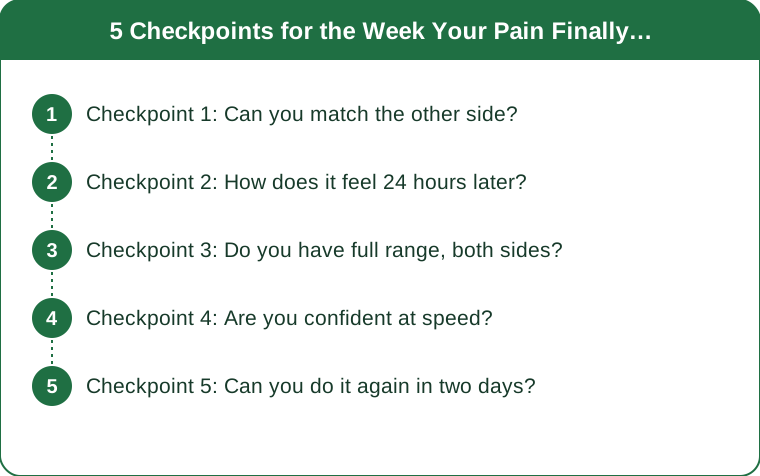
Checkpoint 1: Can you match the other side?
The most objective test available without equipment, and the one people skip because pain-free feels like enough.
Why symmetry matters: an injured limb loses strength quickly and regains it slowly. Research on return to sport after lower limb injury consistently finds that strength and functional symmetry deficits persist long after symptoms resolve, and that returning with a large deficit is associated with higher re-injury rates.
How to test it simply:
- Single-leg calf raises to fatigue. Count on each side. A meaningful gap — commonly more than about 10 percent — is a real deficit.
- Single-leg sit-to-stand from a chair. Count reps on each side.
- Single-leg hop for distance, if appropriate for your injury and if you have been cleared for impact. Compare the distances.
What a good result looks like: within roughly 10 percent side to side. This is a widely used clinical threshold, and it is a reasonable target for ordinary training too.
What to do if you are not there: keep building unilateral strength before adding intensity or volume to bilateral training. The uninjured side will otherwise keep compensating, which is exactly how the imbalance persists.
Test with a professional where possible. A physical therapist has better tests, better norms, and can tell you what applies to your specific injury. This is general information, not medical advice.
Checkpoint 2: How does it feel 24 hours later?
The most important signal in the entire comeback, and the one that requires patience to read.
Why during does not tell you enough: many tissues, particularly tendon, tolerate load fine in the moment and react the following day. Judging a session by how it felt while you did it systematically underestimates the load.
The 24-hour rule: assess the day after, at the same time each day. Ideally the morning after. If the area feels the same as it did before the session, that load was tolerated. If it is more sore or stiff and takes more than about 24 hours to settle, that was too much.
What is acceptable: mild soreness that settles within 24 hours is generally fine and is a normal training response. Pain that increases overnight, wakes you, or is still elevated 48 hours later is not.
Keep an actual record. A one-line note per day — what you did, and a 0 to 10 rating the next morning — takes seconds and gives you a real dataset. Comebacks run on memory are notoriously unreliable, because the good days are more memorable than the bad ones.
Why this checkpoint catches what the others miss: it detects the load that is subtly too much rather than obviously too much, which is the load that accumulates into a setback three weeks later.

Checkpoint 3: Do you have full range, both sides?
Range often returns last, and a restriction that seems minor changes how everything above and below it moves.
How to check: compare directly to the uninjured side, and use a repeatable position so you can measure again in two weeks.
Common examples worth testing:
- Ankle dorsiflexion with the knee-to-wall test — knee touching the wall with the heel down, measuring distance from wall to toe. A side-to-side difference here affects squatting, running mechanics and landing.
- Hip internal and external rotation, seated or lying, comparing sides.
- Shoulder overhead reach and internal rotation behind the back, comparing how far each hand travels.
Why a restriction matters even without pain: the body will find the range somewhere else. Limited ankle dorsiflexion, for instance, produces compensations at the knee and hip during squatting and running. Those compensations are how a resolved ankle injury becomes a knee complaint four months later.
What to do about it: targeted mobility work for the specific restriction, done daily, plus strength work through the newly available range so you can actually use it. Range without strength in that range does not transfer.
And a caution: if range is restricted by a hard block or by pain at the end range rather than by tightness, that is a clinician question, not a stretching one.
Checkpoint 4: Are you confident at speed?
The psychological checkpoint, and it is not a soft one — fear of re-injury is one of the better predictors of failing to return to prior level.
What it looks like in practice: you can do the movement slowly and deliberately without pain, but you hesitate, brace, or subtly protect the limb when the movement is fast, reactive or unplanned.
Why it matters: protective movement patterns change loading. If you unconsciously shift weight away from the injured side during a landing, the other side takes more, and the injured side never re-learns to handle the load.
How to test it: perform a movement you would normally do without thinking — a quick change of direction, a run at moderate pace, a stair descent at normal speed — and notice whether you are thinking about the limb. Film it if you can. Asymmetry that you cannot feel is often visible.
How to build the confidence back: graded exposure. Start with the movement at a speed and complexity where you are genuinely comfortable, and increase one variable at a time. Speed, then unpredictability, then fatigue. Jumping straight to a game or a race is where the fear-driven compensations bite.
When it is more than hesitancy: persistent fear that limits activity, or intrusive worry about re-injury, is common after a significant injury and is something physical therapists and sports psychologists actively work with. It is not something to push through alone.
Checkpoint 5: Can you do it again in two days?
The capacity test, and the one that distinguishes a body that can tolerate a session from a body that can tolerate training.
The question: you did the session and felt fine the next day. Can you repeat it 48 hours later, and feel the same again?
Why this matters more than a single good session: training is repeated exposure. A tissue that handles one session and then needs five days to recover is not yet ready for a normal program. Capacity is the ability to absorb repeated load, and it develops after pain resolves and after strength returns.
How to build it: repeat the same session at the same load for two to three exposures before increasing anything. This is slower than most people want and it is the single most reliable way to avoid the two-steps-forward-one-step-back pattern.
The progression rule that applies here: increase one variable at a time — load, or volume, or frequency, or intensity. Increasing two at once means you cannot tell which one caused a flare-up.
What a green light looks like across all five checkpoints: within 10 percent side to side, no next-day increase in symptoms, full comparable range, no hesitation at speed, and the session repeatable in 48 hours. That combination is a genuine return-to-training signal in a way that pain-free alone is not.
FAQ: Comeback Checkpoint Questions, Answered
How long after pain stops should I wait before returning to normal training?
It depends entirely on the injury and the tissue, which is why the checkpoints are more useful than a timeline. As a general shape, strength and capacity commonly lag pain resolution by weeks, and for tendon injuries often by months.
Should I keep seeing a physical therapist after the pain stops?
This is exactly when many people stop and exactly when the return-to-load guidance is most valuable. A few sessions during the rebuilding phase is often better spent than the same sessions during the painful phase.
What if one checkpoint fails but the others pass?
Address that one specifically and hold the others where they are. A failed checkpoint is information about what to work on, not a reason to restart from zero.
TL;DR:
- Get within about 10 percent side to side on single-leg strength before increasing load.
- Judge every session by how it feels 24 hours later, not during — and write it down.
- Compare range to the uninjured side, and build strength through any range you regain.
- Test the movement at speed; protective hesitation changes loading even when it is unconscious.
- Repeat the same session in 48 hours before progressing anything, and change one variable at a time.
Pain stopping means the tissue calmed down. Strength, range, confidence and capacity are four separate things, and they all still have to be earned.
Keep Reading
This article is for general informational purposes only and is not medical advice. Always consult a qualified health professional for guidance specific to you.